
Positioned at the northwestern tip of Africa where the Mediterranean Sea meets the Atlantic Ocean, Tangier has served as the strategic gateway between Europe and Africa for over two millennia. Located just 14 kilometers (9 miles) across the Strait of Gibraltar from the Spanish coast, the city was administered as an eccentric, duty-free International Zone (1923–1956) under joint European and American oversight, drawing beat generation writers, artists, and political exiles.
In recent years, Tangier has undergone an ambitious economic and architectural revitalization. A modernized marina, restored 17th-century kasbah fortifications, and the terminal of Morocco’s high-speed Al Boraq passenger rail line make Tangier one of the most dynamic entry points into the country. This guide provides practical advice for travelers crossing by ferry from Spain, navigating the city’s dual ports, exploring the historic medina, and traveling onward into northern Morocco.
Tangier Fast Facts for Travelers
- Airport: Tangier Ibn Battouta Airport (TNG), located 12 km southwest of the city center
- Passenger Ferry Ports: Tanger Ville Port (downtown foot passenger terminal) and Tanger Med (cargo/long-distance vehicle port 45 km east)
- High-Speed Rail Hub: Gare de Tanger-Ville (terminal for Al Boraq high-speed trains to Rabat and Casablanca)
- City Taxi Color: Pale blue Petit Taxis with yellow horizontal stripes
- Recommended Stay: 1 to 2 full days
- Best Seasons: May to October (warm Mediterranean coastal weather)
The Two Ferry Ports: A Critical Distinction for Travelers
The most common logistical mistake travelers make when crossing from Spain to Morocco is confusing Tangier’s two separate ferry ports:
| Port | Location | Origin in Spain | Best Suited For | Onward Transit |
|---|---|---|---|---|
| Tanger Ville Port | Directly in downtown Tangier at the base of the medina walls | Tarifa, Spain (FRS / DFDS fast ferries, 60 min crossing) | Foot passengers, backpackers, tourists | Walk directly into the medina or take a 10 MAD taxi to the train station |
| Tanger Med Port | 45 km east of Tangier along the Strait coast | Algeciras, Spain (Baleària, Trasmediterránea, 90 min) & long-haul European car ferries | Commercial trucks, vehicle traffic, budget travelers | Requires a 45-minute bus or Grand Taxi (approx. 40–50 MAD) into Tangier |
Recommendation: If traveling on foot without a vehicle, always book the high-speed catamaran route from Tarifa to Tanger Ville. You will dock directly in the city center, avoiding a 45-kilometer taxi transfer across the northern hills.
Top Things to Do in Tangier
1. Explore the Walled Kasbah & Dar al-Makhzen
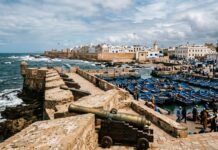
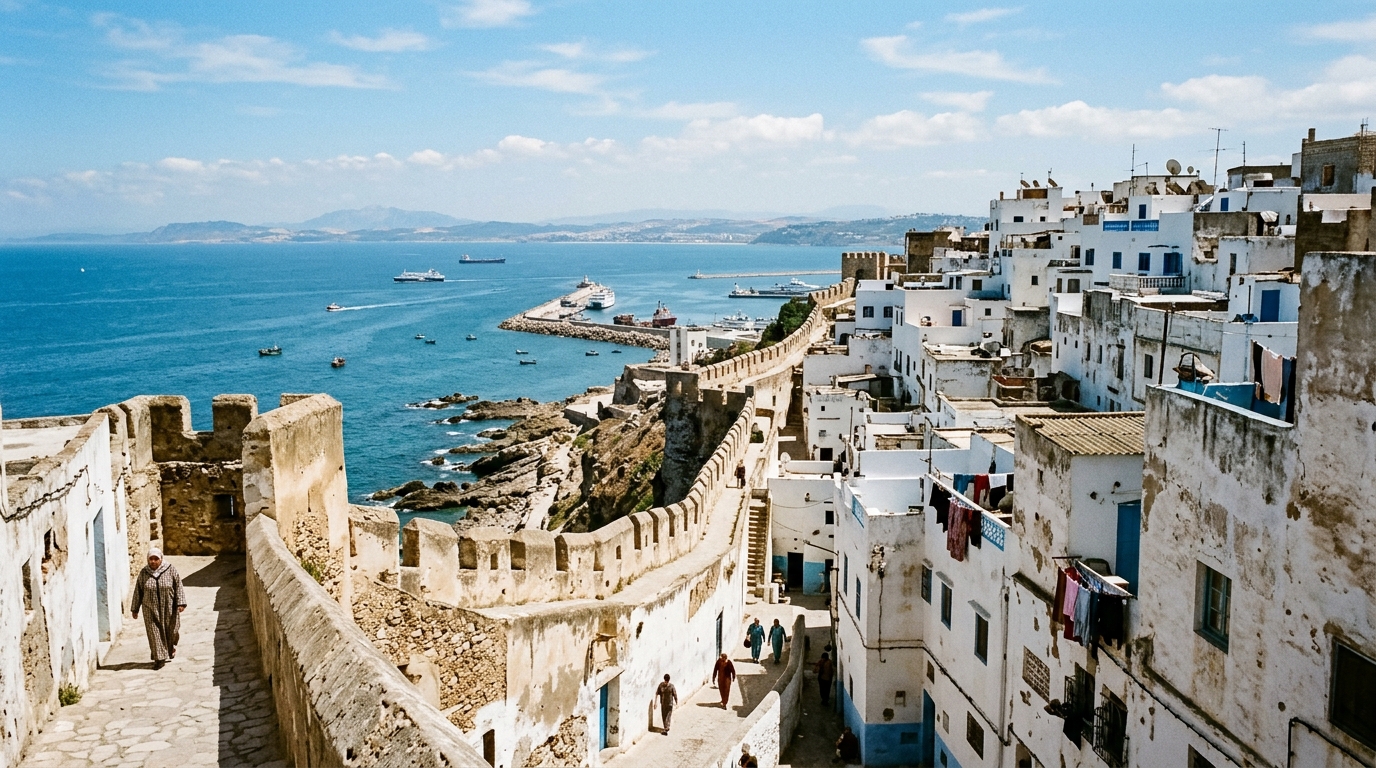
Perched on the highest rocky ridge of the city overlooking the harbor, the Kasbah is an ancient fortified royal enclosure surrounded by 17th-century stone battlements. Enter through the horseshoe archway of Bab Haha to wander quiet whitewashed residential alleys with decorative ceramic tilework and wrought-iron window grilles.
- The Kasbah Museum (Dar al-Makhzen): Housed in the 17th-century former palace of Sultan Moulay Ismail, the museum surrounds an elegant marble courtyard and displays archaeological artifacts from Phoenician, Carthaginian, and Roman settlements across northern Morocco, including an exquisite Roman mosaic of Venus from Volubilis. (Admission: 20 MAD / $2 USD).
- Bab el-Bahr (The Gate of the Sea): Walk to the northern battlements where the ancient gate frames sweeping panoramas across the Strait of Gibraltar. On clear days, the mountains of southern Spain and the Rock of Gibraltar are visible across the water.
2. Sip Mint Tea at Cliffside Café Hafa
Operating continuously since 1921, Café Hafa is Tangier’s most legendary gathering spot. Stepped down the steep limestone cliffs of the Marshan district into tiered open-air concrete terraces, the cafe looks directly out over the blue waters of the Strait of Gibraltar.
- The Legacy: Over the past century, the cafe has hosted figures including the Beatles, the Rolling Stones, Jimi Hendrix, and writer Paul Bowles.
- The Experience: Order a glass of hot mint tea brewed with sprigs of fresh mint and sweet marjoram (15–20 MAD), grab a plastic stool on a lower terrace, and watch massive container ships and fast ferries navigate the strait as the sun sets over the Atlantic horizon.
3. Stroll Grand Socco & Petit Socco
Tangier’s social life centers around two historic public squares linked by the busy commercial artery of Rue Siaghine:
- Grand Socco (Place du 9 Avril 1947): A large, palm-shaded circular plaza centered around a grand marble fountain. It marks the boundary between the modern French-built Ville Nouvelle and the entrance to the medina at Bab Fahs. Visit the iconic 1938 Art Deco Cinema Rif, now operating as the Cinémathèque de Tanger, an independent cinema and cultural cafe.
- Petit Socco (Souq ad-Dakhil): A compact cobblestone plaza in the heart of the lower medina. In the 1930s and 1940s, during the International Zone era, this was the epicenter of expatriate nightlife, financial dealmaking, and espionage. Sit at the outdoor tables of Café Central or Café Tingis to observe medina street life.
4. Discover American History at the Tangier American Legation
Located on Rue d’Amérique in the southern medina, the Tangier American Legation Museum was the first American public property outside the United States, gifted to the young republic in 1821 by Sultan Moulay Suliman (Morocco was the first country to officially recognize the independence of the United States in 1777).
- The Museum: Today, the multi-story mansion operates as an international museum and cultural research center, displaying historic diplomatic correspondence, paintings by American and Moroccan artists, and a dedicated wing documenting the literary works of expatriate author and composer Paul Bowles. (Admission: 50 MAD / $5 USD).
5. Excursion: Cap Spartel & The Caves of Hercules
Located 14 kilometers west of downtown along the scenic Atlantic coastal headland, these two natural landmarks make an essential half-day trip:
- Cap Spartel: A dramatic promontory marking the exact geographical point where the Atlantic Ocean meets the Mediterranean Sea. The historic yellow lighthouse, commissioned by Sultan Mohammed IV in 1864, sits amidst dense maritime pine forests with clifftop walking trails.
- The Caves of Hercules (Grottes d’Hercule): Limestone sea caves steeped in Greco-Roman mythology, where Hercules is fabled to have rested before performing his eleventh labor (stealing the golden apples of the Hesperides). The primary sea cavern features an opening looking out onto the Atlantic surf carved in the shape of the African continent. (Admission: 60 MAD / $6 USD).
- Transit: Hire a Grand Taxi from Grand Socco for the round trip with waiting time (approx. 200–250 MAD / $20–$25 USD).
High-Speed Rail Travel: The Al Boraq Gateway
Tangier serves as the northern terminal station for Africa’s first high-speed train system, the Al Boraq, operated by ONCF:
| Destination | High-Speed Travel Time | 2nd Class Fare | 1st Class Fare |
|---|---|---|---|
| Kenitra | 50 minutes | 95–140 MAD ($10–$14) | 150–210 MAD ($15–$21) |
| Rabat (Rabat-Ville / Agdal) | 1 hour 20 minutes | 115–170 MAD ($12–$17) | 180–260 MAD ($18–$26) |
| Casablanca (Casa-Voyageurs) | 2 hours 10 minutes | 149–224 MAD ($15–$22) | 240–360 MAD ($24–$36) |
Station Information: High-speed trains depart from Gare de Tanger-Ville, a modern glass terminal situated 2 km east of the medina along the beach promenade. The station features digital ticketing kiosks, luggage storage, and an attached shopping mall.
Onward Connections to Chefchaouen
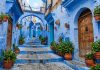
Tangier is the most convenient starting point for visiting the famous blue mountain town of Chefchaouen. Modern, air-conditioned CTM coach buses depart Tangier’s central bus station multiple times daily, reaching Chefchaouen in 2 hours and 15 minutes (fare approx. 50–60 MAD). Alternatively, a private transfer takes 1 hour 45 minutes (approx. 400–500 MAD).
Next Steps for Planning
From Tangier, travel south into the Rif Mountains using our Chefchaouen Travel Guide, take the high-speed Al Boraq train south to explore the capital in our Rabat Travel Guide, or consult our primary Morocco Travel Guide.