
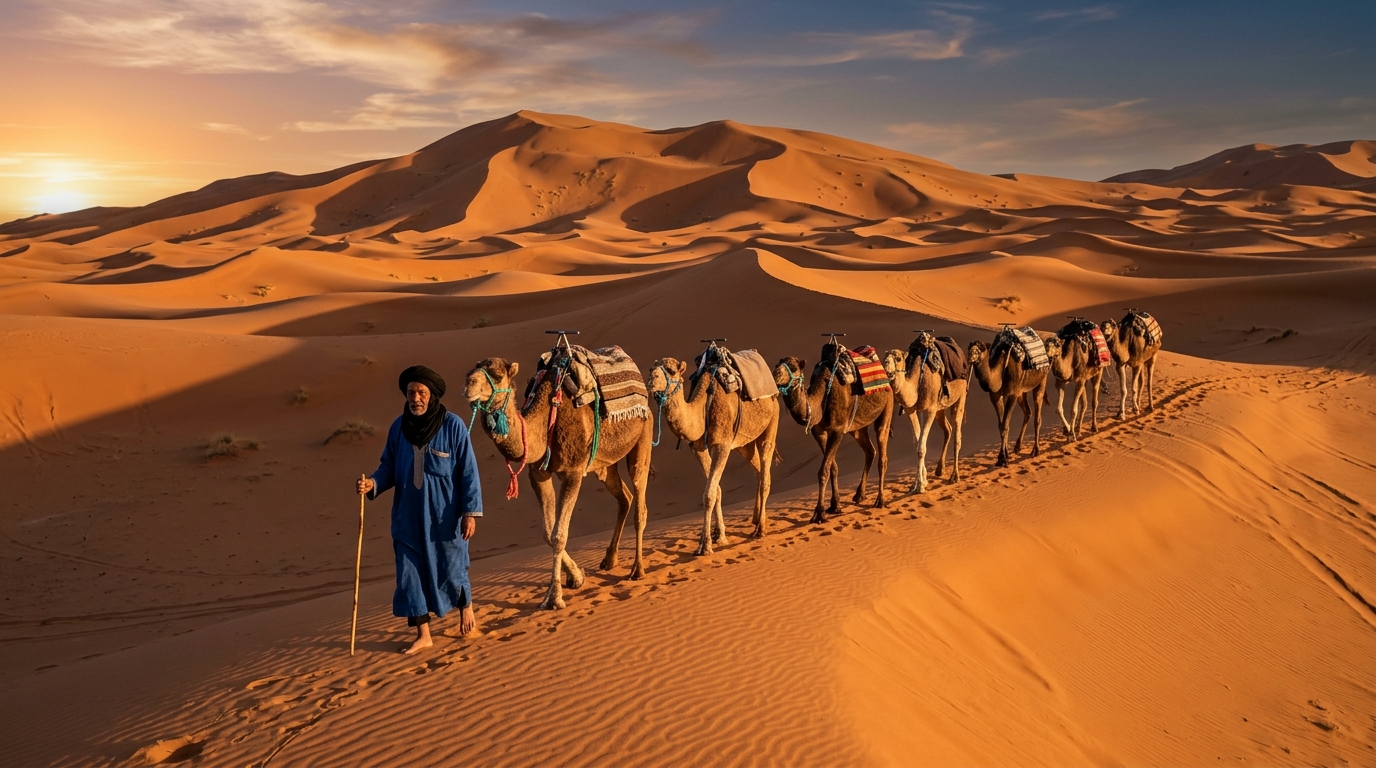
Reaching the Sahara Desert is the central goal of most first-time journeys to Morocco. Standing before an endless sea of wind-sculpted sand dunes at sunset delivers an experience that justifies the long journey across the Atlas Mountains. However, turning a Sahara trip into a reality requires understanding the logistical geography of southern Morocco, which is frequently misrepresented in generic promotional brochures.
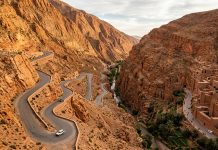
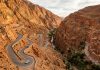
The Sahara does not lie on the edge of Marrakech. Getting to the true sand seas requires traveling between 360 and 560 kilometers across rugged mountain passes, arid valleys, and stone plateaus. Before booking a tour or renting a vehicle, travelers must resolve the single most important decision: choosing between Morocco’s two primary dune fields, Erg Chebbi and Erg Chigaga.
Understanding Erg Chebbi vs Erg Chigaga: The Core Differences
An erg is a large sea of shifting sand dunes, distinct from the gravel plains (reg) and barren stone plateaus (hamada) that make up roughly 80% of the Moroccan desert landscape. Morocco contains two major ergs accessible to travelers, each offering an entirely different travel experience:
| Feature | Erg Chebbi (Merzouga) | Erg Chigaga (M’Hamid) |
|---|---|---|
| Location | Eastern Morocco, near Merzouga & Rissani | Southern Morocco, past M’Hamid El Ghizlane |
| Dune Height | Up to 150 meters (dramatic, steep crests) | Up to 300 meters (sprawling, vast scale) |
| Accessibility | Paved asphalt road leads directly to dune edge | Requires 50–60 km of off-road 4×4 driving (2–3 hours) |
| Distance from Marrakech | 560 km (9–10 hours driving time) | 460 km (8–9 hours driving time) |
| Distance from Fes | 470 km (7–8 hours driving time) | 670 km (11–12 hours, complex connection) |
| Atmosphere | Accessible, developed camps, Wi-Fi, cell service | Remote, wilderness feel, zero cell reception, rugged |
| Best For | First-timers, families, travelers connecting to Fes | Adventure seekers, travelers wanting true isolation |
Erg Chebbi (Merzouga): Accessible Grandeur
Erg Chebbi stretches roughly 28 kilometers north-to-south and up to 7 kilometers east-to-west. The golden-orange dunes rise abruptly from a flat black-stone plain right next to the village of Merzouga. Because modern paved roads run directly along the western boundary of the dunes, any standard two-wheel-drive rental car or public coach can park within steps of local auberges.
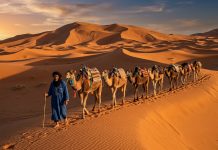
From the auberges, travelers transfer into the dunes via camel trek (typically 45–75 minutes) or a brief 4×4 ride to reach their overnight camp. Erg Chebbi is well-suited for travelers traveling on a tight schedule, those planning an itinerary connecting Marrakech with Fes, or families traveling with small children who need reliable amenities.
Erg Chigaga (M’Hamid): Wilderness & Solitude
Erg Chigaga is substantially larger in geographic area than Erg Chebbi, spanning approximately 40 kilometers with massive ridges rising up to 300 meters. However, reaching Erg Chigaga is an expedition in itself. Paved roads end at the outpost village of M’Hamid El Ghizlane. From M’Hamid, visitors must hire an experienced local Amazigh driver with a rugged 4×4 to navigate 50 to 60 kilometers of trackless desert terrain, dry salt lakes (Lake Iriki), and rocky riverbeds.
Because of this barrier to entry, Erg Chigaga sees a fraction of the visitor numbers that Erg Chebbi receives. There are no paved roads nearby, no village lights visible on the horizon, and virtually no cellular service. If absolute quiet and an untouched desert horizon are your priorities, Erg Chigaga is worth the logistical effort.
Best Time of Year to Visit the Sahara
The Sahara experiences dramatic seasonal and diurnal temperature swings that can dictate the quality of your trip:
- October to November (Autumn): Ideal conditions. Daytime temperatures range from 24°C to 28°C (75°F to 82°F), with mild nights between 12°C and 16°C (54°F to 61°F). Sandstorms are relatively rare.
- December to February (Winter): Crisp, clear sunny days hovering around 18°C to 22°C (64°F to 72°F). However, night temperatures plummet rapidly once the sun drops, frequently dipping to 0°C to 4°C (32°F to 39°F). Traditional nomadic tents have minimal insulation; heavy wool blankets, thermal base layers, and fleece hats are mandatory.
- March to May (Spring): Warm, pleasant daytime conditions (25°C to 32°C / 77°F to 90°F). The primary concern during spring is the Chergui (a dry, hot desert wind) which can stir up intense sandstorms that reduce visibility and coat all equipment in fine grit.
- June to August (Summer): Not recommended for leisure travel. Daytime temperatures consistently exceed 45°C to 48°C (113°F to 118°F). Most reputable desert camps close entirely between mid-June and late August because midday heat in unconditioned tents is dangerous.
Desert Camps: Standard vs Luxury
Accommodations inside the dunes generally fall into two categories:
1. Standard Nomad Camps (600–1,000 MAD / $60–$100 USD per night)
Standard camps consist of black wool or synthetic canvas tents pitched in a circle or U-shape around a central fire pit. Sleeping quarters feature basic foam mattresses on carpets or raised wooden bed frames with clean blankets and sheets. Bathrooms are communal, featuring shared flush toilets and basic cold/warm water showers located in a separate utility structure. Electricity is supplied by limited solar batteries or a diesel generator that shuts off around 10:00 PM.
2. Luxury Desert Camps (1,800–4,000 MAD / $180–$400 USD per night)
Luxury camps offer spacious walk-in safari tents equipped with king-size beds, decorative Berber rugs, bedside tables, and private en-suite bathrooms. These en-suite setups feature private chemical flush toilets, heated running water showers, and porcelain sinks. Most luxury camps run solar-inverter systems providing 24-hour electricity with in-tent power outlets for charging cameras and phones. Multi-course Moroccan dinners and full breakfasts are served in a dedicated dining pavilion.
A Typical 24-Hour Desert Experience
Understanding how a desert stay flows helps in pacing your travel days:
- Late Afternoon (4:30 PM – 5:30 PM): Arrive at the staging auberge. Repack personal essentials into a small daypack (large rolling suitcases remain stored in the auberge or vehicle trunk). Meet your camel guide.
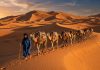
- Sunset Trek (5:30 PM – 6:45 PM): Mount your dromedary camel for a caravan ride into the interior dunes. The guide pauses on a ridgeline so you can dismount and climb the crest to watch the sunset shift the sand from bright gold to deep ochre.
- Camp Arrival & Dinner (7:30 PM – 9:30 PM): Arrive at camp, settle into your tent, and share a pot of hot mint tea. A freshly prepared Moroccan dinner is served—usually Harira soup followed by slow-simmered beef or chicken tagine and seasonal fruit.
- Stargazing & Campfire (9:30 PM – 11:00 PM): Local staff build a tamarisk wood fire and play traditional Amazigh drum rhythms (darbouka). Due to the total lack of light pollution, the Sahara night sky reveals the full arc of the Milky Way.
- Sunrise (6:00 AM – 7:00 AM): Wake up early to hike up the eastern face of the nearest high dune. Morning light provides the sharpest shadows and cleanest photographic contrasts across undisturbed sand ripples.
- Breakfast & Return (7:30 AM – 9:00 AM): Enjoy fresh bread, boiled eggs, olives, and coffee before traveling back to Merzouga by camel or 4×4 to resume your road trip.
How Much Does a Sahara Trip Cost?
Budgeting for the desert depends primarily on your transit method and party size:
- Shared 3-Day Group Tour from Marrakech: 900 to 1,400 MAD ($90 to $140 USD) per person. Includes basic minibus transit, driver, one night in Dades Valley, one night in a standard Merzouga camp, dinners, and camel rides. Expect large groups (14–17 people), long fixed stops at cooperative shops, and basic accommodations.
- Private 3-Day / 2-Night Tour: 4,000 to 7,500 MAD ($400 to $750 USD) total for two passengers in a modern 4×4. Includes a dedicated professional driver, fuel, mid-range Dades hotel, luxury Erg Chebbi desert camp, and flexible pacing.
- Independent Rental Car & Camp Booking: Car rental runs 250–400 MAD/day ($25–$40 USD); fuel costs around 600–800 MAD ($60–$80 USD) round trip; a self-booked luxury desert camp costs 1,500–2,500 MAD ($150–$250 USD) for two with half-board.
Essential Gear for the Sahara
Fine desert sand is abrasive and pervasive. Pack these key items in your daypack:
- Cotton Tagelmust (Cheche): The 4-to-5-meter Berber headscarf sold in southern towns (50–100 MAD). Wrapped properly around the head and face, it protects eyes, nose, and mouth during gusts far better than a baseball cap or bandanna.
- Closed Footwear: Running shoes or lightweight trail shoes are preferable to open sandals. Dune sand absorbs heat rapidly during sunny hours and cools drastically at night.
- High-Capacity Power Bank: Desert night temperatures sap smartphone batteries quickly, and standard camps have limited or scheduled charging outlets.
- Zippered Plastic Bags: Seal cameras, phones, and lenses inside protective zip-top bags when not actively shooting to keep micro-sand out of mechanical dials and zoom rings.
- Warm Layers: A fleece pullover, windbreaker, and thermal long underwear for overnight stays between November and March.
For detailed route planning between Marrakech and the dunes, review our comprehensive 10-day Morocco itinerary and our step-by-step breakdown on Morocco trip costs.