
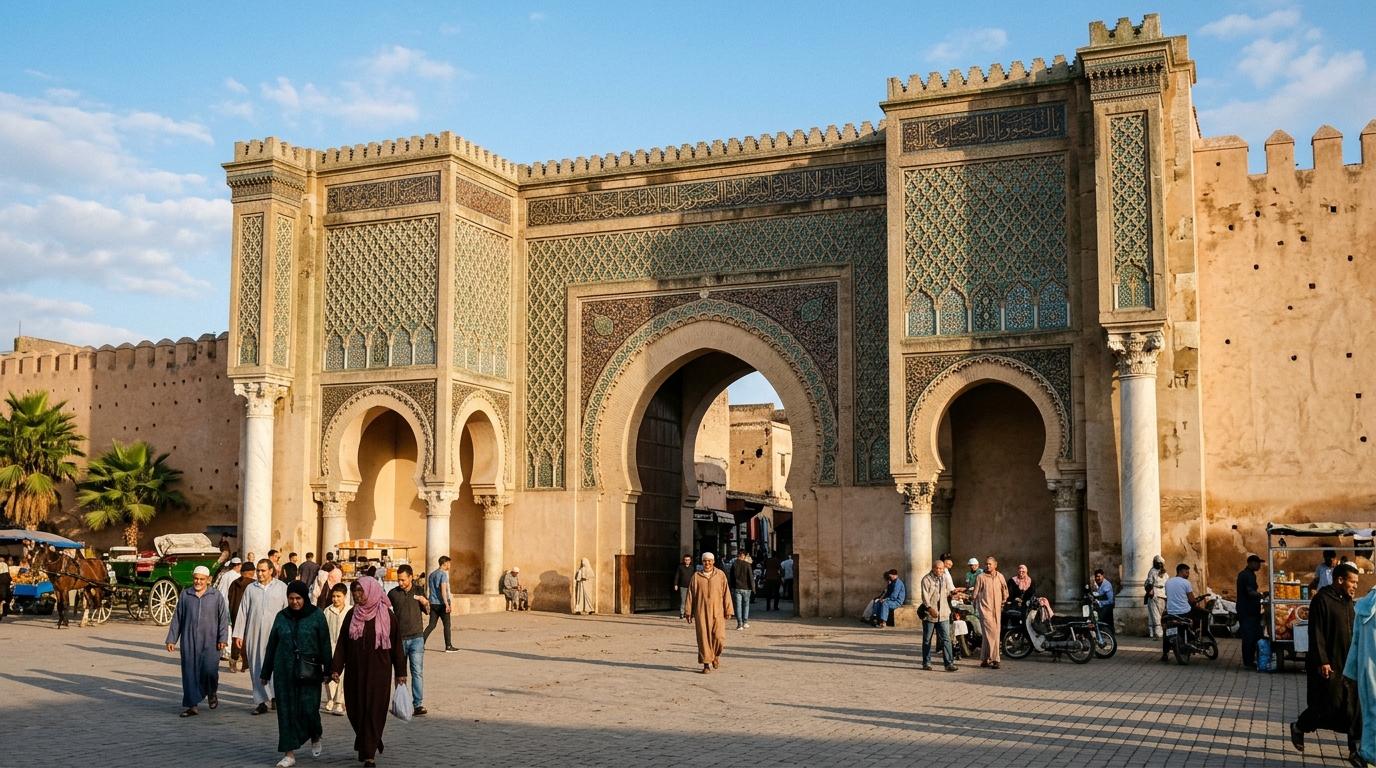
Often overshadowed by its neighboring imperial sister Fes, Meknes is one of Morocco’s four historical imperial capitals, defined by monumental scale and ambition. In the late 17th century, the Alaouite Sultan Moulay Ismail (who reigned from 1672 to 1727) relocated the national capital from Fes to Meknes, embarking on a colossal 50-year construction campaign intended to rival the Versailles of his contemporary, France’s Louis XIV.
The Sultan enclosed the city within 45 kilometers of monumental rammed-earth defensive walls (pisé), constructed 20 massive fortified ceremonial gates, built royal granaries capable of feeding an army, and carved vast underground water reservoirs. Today, Meknes offers a relaxed, unhurried alternative to the chaotic medinas of Marrakech and Fes, combined with immediate access to Volubilis, Morocco’s best-preserved Roman archaeological site. This guide covers how to explore the imperial city, visit the Roman ruins, and plan transportation.
Meknes Fast Facts for Travelers
- Location: Saïss agricultural plain, 60 km west of Fes / 140 km east of Rabat
- Passenger Rail: On the main ONCF line connecting Fes to Rabat and Casablanca (trains run hourly)
- Primary Rail Stations: Gare de Meknès (main terminal) and Gare de Meknès-Amir Abdelkader (closer to downtown Ville Nouvelle)
- City Taxi Color: Pale blue / light blue Petit Taxis
- Recommended Stay: 1 to 2 days (or an easy full-day excursion from Fes)
- Best Seasons: April to May (blooming agricultural plains) and September to November
Top Historical Attractions in Meknes
1. Bab El-Mansour (The Grand Ceremonial Gate)
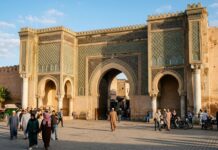
Completed in 1732 under Moulay Ismail’s son, Sultan Moulay Abdallah, Bab El-Mansour (officially Bab Mansour Laleuj) is widely regarded as the most magnificent architectural gateway in North Africa. Designed by a Christian convert to Islam named Mansour, the gate served as the primary ceremonial entrance leading from the public city into the private imperial palaces.
- Architectural Features: The central horseshoe arch is framed by massive side bastions supported by towering Corinthian marble columns—which Moulay Ismail looted directly from the nearby Roman ruins of Volubilis and the Badi Palace in Marrakech. The gate’s facade is covered in intricate cobalt-blue and turquoise glazed zellij tilework, interlaced arabesque stucco, and carved Arabic inscriptions praising the Sultan.
- Location: Facing Place El-Hedim; an ideal photography stop in the morning when the sun illuminates the eastern tilework.
2. Place El-Hedim (“The Square of Demolition”)
Directly facing Bab El-Mansour lies Place El-Hedim, a vast public rectangular plaza. To construct his grand imperial city, Moulay Ismail ordered the demolition of an entire residential neighborhood, creating an expansive open staging ground for royal military parades and royal proclamations (giving the square its name, meaning “Square of Demolition and Rubble”).
Today, Place El-Hedim functions as a relaxed, family-friendly gathering space. Sidewalk cafes line the western arcade, street performers gather crowds in the evenings, and fresh fruit vendors sell local dates and figs. It provides an authentic taste of Moroccan civic life without the intense tourist congestion of Marrakech’s Jemaa el-Fna.
3. Heri es-Souani (Royal Granaries & Stables)
Located two kilometers south of the medina along the imperial walls, Heri es-Souani illustrates the staggering logistical engineering of Moulay Ismail’s empire. The massive stone complex served as the royal grain storage depot and cavalry stable for the Sultan’s 12,000 personal thoroughbred Arabian war horses.
- The Granaries: Massive vaulted stone halls constructed with walls up to four meters thick and deep sub-floor air ducts designed to maintain a cool, steady temperature, keeping grain dry and edible for years in anticipation of military sieges.
- The Stables: A vast, roofless expanse of hundreds of stone arches stretching into the distance. (The cedar roof collapsed during the great Lisbon earthquake of 1755). Each stall featured an individual stone feeding trough and a private freshwater channel fed by underground waterwheels. (Admission: 70 MAD / $7 USD).
4. Bassin de l’Agdal (Sahrij Swani)
Directly adjacent to Heri es-Souani lies the Bassin de l’Agdal, an immense 4-hectare artificial stone-walled reservoir. Commissioned by Moulay Ismail, the basin was fed by an intricate 25-kilometer network of subterranean hydraulic canals (khettara) and 10 waterwheels (norias) powered by mules.
The reservoir served a dual purpose: irrigating the vast royal citrus and olive orchards surrounding the imperial enclosure, and providing a continuous water supply to the palace and stables during wartime. Today, it serves as a peaceful waterside park where local families stroll in the late afternoon.
5. Mausoleum of Moulay Ismail
This sacred funerary complex houses the tomb of Sultan Moulay Ismail alongside his wife and son. Unlike most religious sanctuaries in Morocco, the Mausoleum of Moulay Ismail welcomes non-Muslim visitors into its outer courtyards and tomb viewing antechamber.
- The Architecture: Visitors pass through a series of quiet, yellow-walled sunlit courtyards paved in marble before entering an interior sanctuary adorned with intricate zellij mosaics, carved plasterwork, and grandfather clocks gifted to the Sultan by France’s King Louis XIV.
- Visitor Rules: Admission is free (small tips for attendants appreciated). Visitors must remove their shoes at the entrance to the carpeted antechamber. Modest dress covering shoulders and knees is strictly enforced.
6. Bou Inania Madrassa (Meknes)
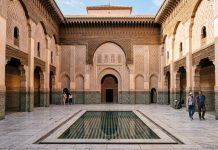
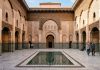
Not to be confused with its namesake in Fes, the Bou Inania Madrassa in Meknes was commissioned in the mid-14th century by Marinid Sultan Abu al-Hasan and completed by his son Abu Inan. Located inside the covered medina souks, this compact Islamic theological college features a central courtyard with a marble ablution basin, detailed cedar woodwork, and student dormitory rooms upstairs. Climb to the roof for views over the green-tiled roof of the Grand Mosque. (Admission: 20 MAD / $2 USD).
The Essential Day Trip: Roman Volubilis & Moulay Idriss
No visit to Meknes is complete without an excursion to Volubilis (known locally as Oualili), situated 30 kilometers north across rolling hills of olive groves and wheat fields:
Volubilis: Morocco’s Premier Roman Ruins
Inscribed as a UNESCO World Heritage site, Volubilis was the southwesternmost administrative capital of the Roman Empire, flourishing from the 1st to 3rd centuries AD as a major exporter of wheat, olive oil, and wild animals (lions and leopards) for gladiatorial spectacles in Rome.
- What to See: The ancient city remains remarkably intact. Walk the paved Decumanus Maximus highway, view the imposing Triumphal Arch of Caracalla (built in 217 AD), inspect the Capitoline Temple and Basilica columns, and examine over thirty preserved in-situ floor mosaics, including The Labors of Hercules, Bacchus in a Chariot Drawn by Panthers, and Diana Bathing.
- Admission: 70 MAD (~$7.00 USD). Hire an official licensed multilingual guide at the ticket office (approx. 200–250 MAD for 90 minutes) to bring the ruins to life.
- Timing Tip: There is almost no shade on the archaeological site. Visit early in the morning or late afternoon, especially between May and September.
Moulay Idriss Zerhoun
Located five kilometers from Volubilis, the whitewashed holy town of Moulay Idriss Zerhoun is dramatically draped across two rocky hill ridges. In 789 AD, Moulay Idris I (great-grandson of the Prophet Muhammad) arrived here fleeing Abbasid persecution in Baghdad, founding the first Moroccan Islamic state and the Idrisid dynasty.
For centuries, the town was closed to non-Muslims overnight. Today, foreign travelers can visit freely, explore the winding whitewashed stairways, and sample famous local spiced lamb brochettes (skewers) in the central plaza. Non-Muslims cannot enter the tomb of Moulay Idris, but can view its green-tiled roof from elevated hillside terraces.
Transportation & Getting to Meknes
Passenger Rail (ONCF)
Meknes is one of the most accessible cities in Morocco via rail, situated on the main northern railway trunk line:
- Fes to Meknes: 35 to 45 minutes on regular express trains (trains run roughly every hour; fare 22–35 MAD / $2–$3.50 USD).
- Rabat to Meknes: 2 hours 15 minutes (fare approx. 65–80 MAD).
- Casablanca to Meknes: 3 hours 15 minutes (fare approx. 95–125 MAD).
Station Advice: Trains stop at two stations in town: Gare de Meknès (the large main terminal) and Gare de Meknès-Amir Abdelkader. If your hotel is located in the modern Ville Nouvelle or you are heading directly to the medina, alight at Amir Abdelkader, which is closer to the center.
How to Travel from Meknes to Volubilis
- Private Grand Taxi Charter (Recommended): Hire a Grand Taxi from the taxi rank near the Institut Français or Amir Abdelkader station for a half-day excursion covering Volubilis and Moulay Idriss Zerhoun. A private charter typically costs 250 to 350 MAD ($25–$35 USD) total for the vehicle, including two hours of waiting time while you explore the ruins.
- Public Shared Grand Taxi: Take a shared Grand Taxi from the station to Moulay Idriss town (15 MAD per seat). From the Moulay Idriss taxi stand, take a local taxi or walk the scenic 4 km downhill road to the Volubilis entrance gate (10–15 MAD).
Next Steps for Planning
Because Meknes is only 45 minutes by train from Fes, pair your visit with our Fes Travel Guide, see how both imperial cities fit into our 10-day Morocco itinerary, and review transit options in our Morocco Travel Guide.