
Ten days is the ideal timeframe for a first visit to Morocco. This route connects the country’s two most culturally significant imperial cities—Marrakech and Fes—with a three-day overland crossing through the High Atlas Mountains, earthen kasbah valleys, and the sand dunes of the Sahara Desert, finishing in the blue mountain town of Chefchaouen.
The key to making a 10-day trip manageable is booking an open-jaw (multi-city) flight: flying into Marrakech Menara Airport (RAK) and departing from Casablanca Mohammed V (CMN) or Tangier (TNG). This point-to-point route saves 9 hours of driving by eliminating the need to backtrack across the Atlas range to your starting point.
Itinerary Summary at a Glance
| Day | Routing / Overnight | Driving Distance | Transit Time | Key Highlights |
|---|---|---|---|---|
| Day 1 | Arrive in Marrakech | — | 30 min (taxi) | Medina check-in, Jemaa el-Fna evening food stalls |
| Day 2 | Marrakech | — | Walking | Bahia Palace, Ben Youssef Madrassa, Saadian Tombs, Souks |
| Day 3 | Marrakech | — | Short taxi | Jardin Majorelle, YSL Museum, local hammam experience |
| Day 4 | Marrakech → Dades Valley | 315 km | 6 hours | Tizi n’Tichka pass, Ait Ben Haddou, Ouarzazate |
| Day 5 | Dades Valley → Merzouga (Sahara) | 265 km | 4.5 hours | Todra Gorge canyon walk, Erg Chebbi camel trek, desert camp |
| Day 6 | Merzouga → Fes | 470 km | 7.5 hours | Dune sunrise, Ziz Valley palm groves, Midelt, Azrou cedar forest |
| Day 7 | Fes | — | Walking | Fes el-Bali medina, Chouara Tannery, Al-Qarawiyyin |
| Day 8 | Fes → Chefchaouen | 210 km | 3.5–4 hours | Scenic Rif mountain drive, blue-washed medina exploration |
| Day 9 | Chefchaouen → Casablanca (or Rabat) | 340 km | 4.5–5 hours | Spanish Mosque morning hike, transfer to coastal rail corridor |
| Day 10 | Casablanca & Departure | — | 45 min (train) | Hassan II Mosque guided tour, CMN airport departure |
Day 1: Arrival and Orientation in Marrakech
Land at Marrakech Menara Airport (RAK). After clearing customs and getting your passport stamped with your police file number (Numéro d’Entrée), withdraw Moroccan Dirhams from an official bank ATM in the arrivals hall and purchase a physical SIM or eSIM from the Maroc Telecom kiosk.
Take an official taxi (flat rate roughly 100–150 MAD to the medina perimeter) to the drop-off point nearest your riad. Because luggage vehicles cannot enter the narrow alleys of the medina, riad staff or cart porters (expect to tip 20–30 MAD) will guide you on foot to your accommodation.
Spend late afternoon unwinding from travel. Before sunset, walk to Jemaa el-Fna, Marrakech’s central open square. Secure a seat on a second-story rooftop cafe terrace (such as Café de France or Le Grand Balcon du Café Glacier) to watch the open-air food stalls light up as the evening call to prayer echoes across the city.
Day 2: Historical Marrakech & The Medina Souks
Dedicate your first full morning to the city’s key architectural landmarks before midday crowds peak:
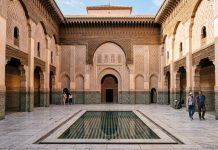
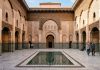
- Ben Youssef Madrassa (9:00 AM): This 14th-century Islamic college accommodated up to 900 students. Its central courtyard features elaborate carved cedar, geometric zellij tilework, and sculpted stucco. Entry: 50 MAD.
- Bahia Palace: Built in the late 19th century, this sprawling palace features painted ceilings and quiet interior courtyards planted with orange trees and jasmine. Entry: 70 MAD.
- Saadian Tombs: Sealed for centuries until rediscovered by aerial photography in 1917, these mausoleums house the remains of Sultan Ahmad al-Mansur and his descendants beneath vaulted Italian Carrara marble ceilings. Entry: 70 MAD.
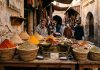
Spend the afternoon exploring the labyrinthine souks extending north from Jemaa el-Fna: Souk Semmarine (textiles and leather), Souk Haddadine (blacksmiths and iron lamps), and Rahba Kedima (the spice square). Remember that walking away politely is your best tool when bargaining.
Day 3: Majorelle Garden & Gueliz
Take a Petit Taxi northwest of the medina into the French colonial district of Gueliz. Pre-book timed entry tickets online for the Jardin Majorelle, the cobalt-blue botanical garden created by French painter Jacques Majorelle and later preserved by Yves Saint Laurent and Pierre Bergé.
Adjacent to the garden is the Musée Yves Saint Laurent Marrakech, displaying iconic haute couture collections inspired by Moroccan textiles and color palettes. Spend the afternoon booking a traditional hammam treatment at a medina bathhouse or relaxing on your riad terrace before the long overland journey begins tomorrow.
Day 4: Across the High Atlas to Ait Ben Haddou and the Dades Valley
Route: Route N9 across the Tizi n’Tichka pass → Ait Ben Haddou → Ouarzazate → Boumalne Dades (315 km, 6–7 hours driving with stops).
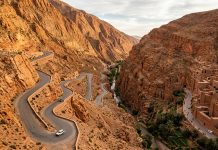
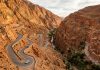
Depart Marrakech by 8:00 AM. Route N9 winds up through the High Atlas Mountains, reaching its apex at the Tizi n’Tichka pass (2,260 meters). The drive features dramatic switchbacks, Berber stone settlements, and panoramic alpine views.
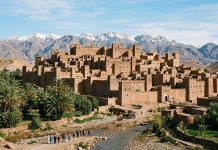
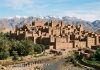
Shortly past the pass, take the detour to Ait Ben Haddou, a UNESCO World Heritage site and one of North Africa’s most intact examples of earthen clay architecture (ksar). Walk across the shallow riverbed and climb through the fortified alleys to the granary at the summit for views over the desert plains.
Continue east past Ouarzazate along the “Road of a Thousand Kasbahs” into the Dades Valley, famous for its dramatic rock formations known as the “Monkey Fingers.” Check into an auberge along the Dades Gorge for dinner and an overnight stay.
Day 5: Todra Gorge to the Sahara Desert (Erg Chebbi)
Route: Dades Valley → Tinghir → Todra Gorge → Erfoud → Merzouga (265 km, 4.5 hours driving).
Drive east toward the oasis town of Tinghir, turning into the Todra Gorge. Here, sheer limestone canyon walls rise 300 meters above a narrow riverbed, offering a pleasant 45-minute walking stop.
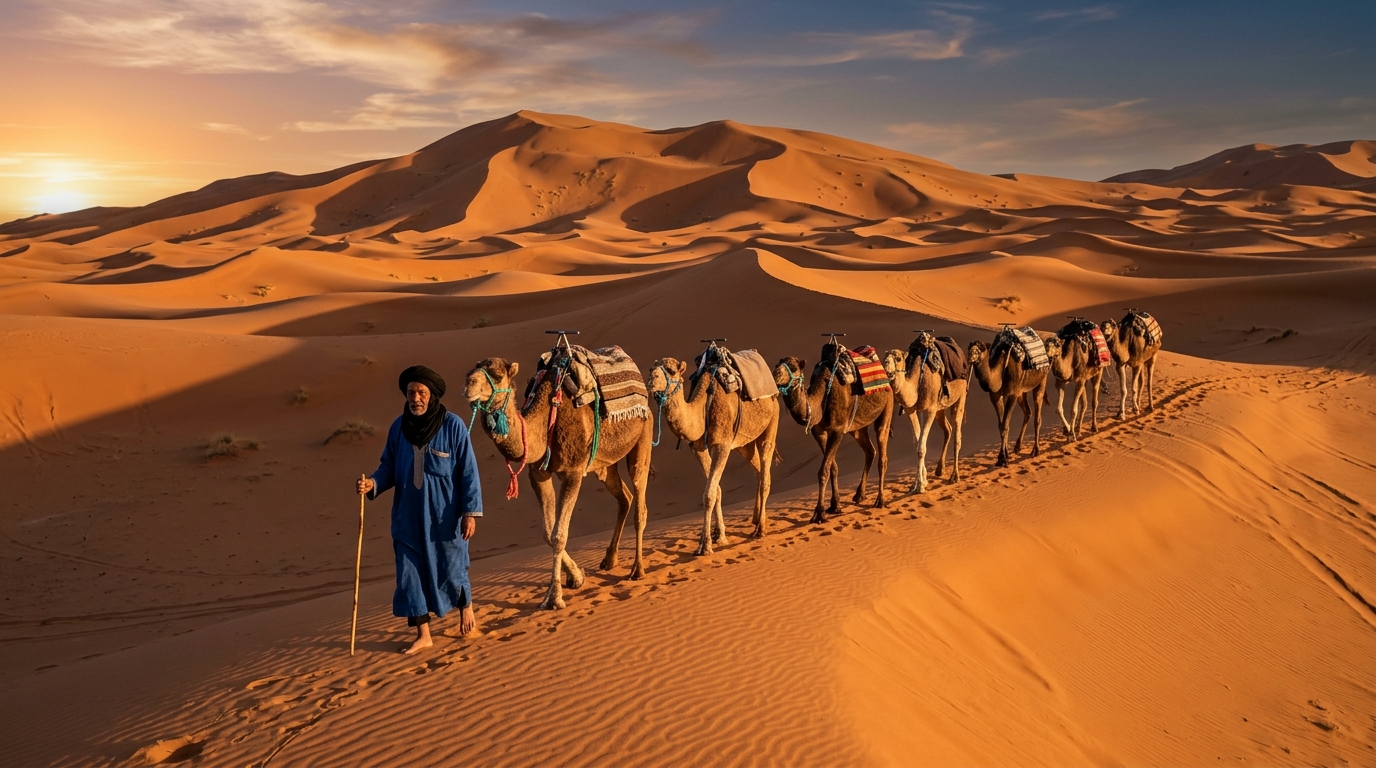
Continue southeast through the date palm oases of Erfoud and Rissani to the desert settlement of Merzouga, where the paved road ends at the foot of Erg Chebbi—a 28-kilometer-long sea of orange sand dunes rising up to 150 meters high.
Leave heavy luggage in a secure base hotel and mount camels (or board a 4×4) by 5:00 PM for the 90-minute trek into the dunes as the sun lowers. Arrive at your desert camp in time for sunset, followed by a traditional dinner of tajine, live Berber drumming around a campfire, and clear stargazing under unpolluted desert skies.
Day 6: Merzouga to Fes via the Ziz Valley and Middle Atlas
Route: Merzouga → Er-Rachidia → Midelt → Azrou → Ifrane → Fes (470 km, 7.5–8 hours driving).
Wake before dawn to climb the nearest dune ridge for sunrise over the Algerian border. After breakfast, trek out of the dunes and begin the longest driving day of the itinerary heading north on Route N13.
The route passes through the dramatic palm canyon of the Ziz Valley before climbing into the barren Middle Atlas plateau toward the apple-farming town of Midelt, the standard lunch stop. In the afternoon, descend through the ancient cedar forests of Azrou, home to troops of wild Barbary macaque monkeys. Pass through Ifrane, a clean alpine town known for pitched red roofs and ski resorts, before arriving in Fes by late afternoon.
Day 7: The Medieval Heart of Fes el-Bali
Fes is the intellectual and spiritual capital of Morocco. Hire a licensed local guide through your riad for a morning walking tour of Fes el-Bali, the world’s largest car-free medieval city:
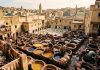
- Chouara Tannery: View the stone dye vats from surrounding leather shop terraces. Men submerge animal hides in natural pigments (saffron, indigo, poppy, and cedar) using techniques unchanged since the 11th century. Mint sprigs are provided at the door to mask the strong odor of pigeon droppings used in curing.
- Al-Qarawiyyin Mosque and University: Founded in 859 AD by Fatima al-Fihri, this is recognized as the oldest continuously operating university in the world. (Non-Muslims cannot enter the mosque interior but can view the courtyard from the doorways).
- Al-Attarine Madrassa: Remarkable 14th-century student college featuring cedar wood carvings and intricate tile mosaic work.
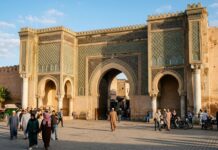
In the afternoon, visit the Pottery Quarter (Ain Nokbi) to watch artisans chip individual clay zellij tiles by hand, or view the golden brass gates of the Royal Palace (Dar al-Makhzen).
Day 8: Fes to Chefchaouen (The Blue City)
Route: Fes → Ouazzane → Chefchaouen (210 km, 3.5–4 hours driving or CTM bus).
Depart Fes north into the Rif Mountains. Arrive in Chefchaouen by early afternoon. Because no vehicles can enter the medina, you will walk up the cobblestone steps to your guesthouse.
Spend the afternoon exploring the quiet, blue-washed residential quarters of Al-Andalus and Souika. An hour before dusk, take the 20-minute uphill path from the Bab el-Ansar gate to the abandoned Spanish Mosque for panoramic sunset views over the entire blue settlement nestled against the mountain peaks.
Day 9: Chefchaouen to Casablanca (or Rabat)
Route: Chefchaouen → Tangier (2.5h by bus/car) → Al Boraq high-speed train to Casablanca (2h 10m).
Enjoy a relaxed morning breakfast on a rooftop terrace in Chefchaouen. Mid-morning, take private transport or a coach bus north to Tangier Ville rail station. Board the modern Al Boraq high-speed train, which cruises south at 320 km/h, reaching Rabat in 1 hour 20 minutes and Casablanca Voyageurs station in 2 hours 10 minutes.
Check into your hotel in Casablanca or Rabat. If staying in Rabat, explore the whitewashed coastal Kasbah of the Udayas and the historic Hassan Tower before an evening seaside dinner.
Day 10: Casablanca (Hassan II Mosque) and Departure
Spend your final morning visiting Casablanca’s landmark architectural achievement: the Hassan II Mosque. Completed in 1993, it is one of the largest mosques in the world, with a 210-meter minaret standing on a rocky outcrop projecting into the Atlantic Ocean.
It is one of the few active religious sites in Morocco open to non-Muslim visitors via structured, multilingual guided tours (tickets approx. 130 MAD). The prayer hall accommodates 25,000 worshippers under a motorized retractable roof with heated marble floors.
From downtown Casablanca (Casa-Port or Casa-Voyageurs stations), direct ONCF shuttle trains run every 30 to 60 minutes straight into the basement terminal of Casablanca Mohammed V Airport (CMN) in 35 minutes (fare approx. 50 MAD) for your outbound flight home.
Transportation Options for This 10-Day Route
| Option | Estimated Cost | Pros | Cons |
|---|---|---|---|
| Rental Car (Self-Drive) | $25–$45 / day + fuel ($150) | Total scheduling freedom; stop at viewpoints whenever you want | Mountain switchbacks require confident driving; medinas have no parking |
| Private Car with Driver | $150–$250 / day total | Zero driving stress; door-to-door luggage handling; local cultural guide | Higher cost for solo travelers; fixed schedule coordination |
| Public Transit (Train + CTM) | $80–$120 per person total | Extremely affordable; relaxed travel between major cities | Public buses do not easily connect remote stops like Todra Gorge and Ait Ben Haddou |
Next Steps for Trip Preparation
To prepare your budget and gear for this 10-day route, consult our companion guides on how much a trip to Morocco costs, the best time of year to visit, and our primary Morocco Travel Guide.