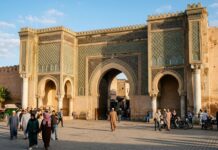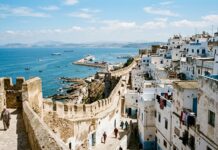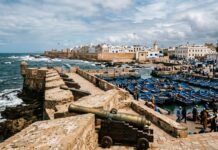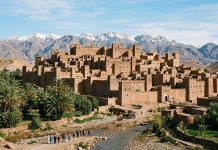

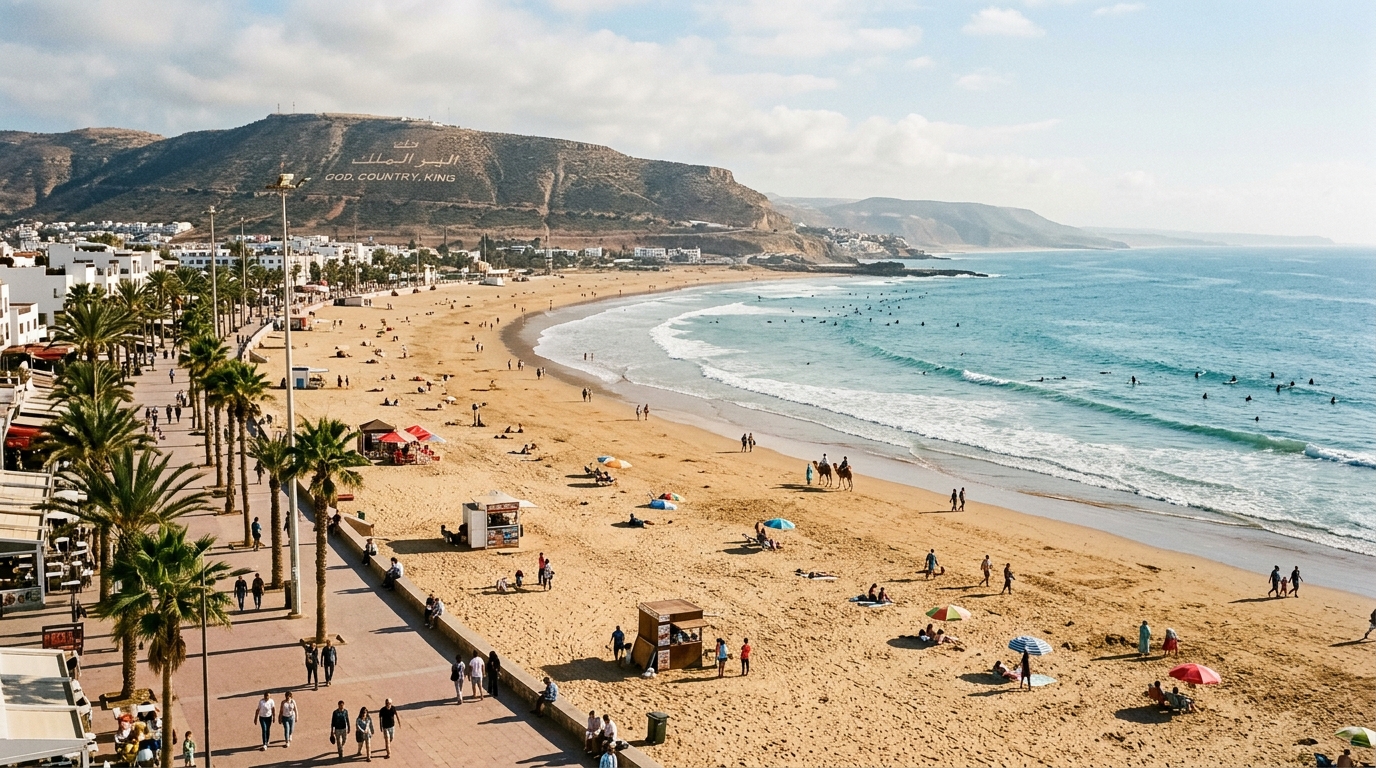
Unlike the ancient medieval medinas of northern Morocco, Agadir is a modern, resort-oriented coastal city defined by wide palm-lined boulevards, beachfront hotels, and an expansive 10-kilometer crescent of golden sand. Rebuilt from the ground up following a catastrophic 1960 earthquake, Agadir functions as Morocco’s premier winter sun destination, boasting over 300 days of sunshine each year.
Just 19 kilometers north along the Atlantic coast lies Taghazout, a former Berber fishing hamlet that has transformed into one of the world’s leading surf destinations, renowned for right-hand point breaks like Anchor Point. Together, Agadir and Taghazout offer an active coastal hub combining world-class surfing, relaxed beach life, the enormous artisan markets of Souk El Had, and mountain day trips into the High Atlas foothills. This guide covers how to choose between the two towns, key surf spots, markets, and regional excursions.
Agadir & Taghazout Fast Facts for Travelers
- Airport: Agadir Al Massira Airport (AGA), located 25 km southeast of the city center
- Transit Access: Highway only (no passenger rail). Connected via high-speed motorway (A3) to Marrakech (3.5 hours) and coastal highway to Essaouira (3 hours)
- City Taxi Color: Red/Orange Petit Taxis in Agadir (metered, flat minimum 7–8 MAD)
- Recommended Stay: 3 to 5 days for a relaxed beach, surf, and wellness stay
- Best Seasons: Year-round for beach relaxation; October to April for peak Atlantic surf swells
Agadir vs. Taghazout: Where Should You Stay?
While only 20 minutes apart by road, Agadir and Taghazout cater to fundamentally different travel styles:
| Feature | Agadir | Taghazout |
|---|---|---|
| Atmosphere & Vibe | Modern resort city, paved beach promenade, European-style marina, family hotels | Bohemian surf town, rooftop yoga retreats, cafes, digital nomad hub |
| Beach Conditions | Sheltered crescent bay; calm water suitable for swimming and paddleboarding | Open ocean swells; world-class point breaks and beach surf breaks |
| Accommodation Types | Large all-inclusive beachfront resorts, international chains, serviced apartments | Boutique surf camps, eco-lodges, shared apartments, luxury resorts at Taghazout Bay |
| Nightlife & Dining | International restaurants, seafood bistros, hotel bars, modern sports lounges | Health-food cafes, smoothie bars, surf hostels, laid-back beach grills |
| Best Suited For | Families, sunbathers, older travelers, shopping at Souk El Had | Surfers (beginner to pro), solo travelers, remote workers, yoga enthusiasts |
Top Things to Do in Agadir
1. Explore Souk El Had: Morocco’s Largest Urban Market
Covering 13 hectares enclosed by high crenellated walls with 13 numbered entry gates, Souk El Had is the largest urban market in Morocco, containing over 6,000 independent shops and stalls. Unlike the congested, winding alleys of Fes or Marrakech, Souk El Had is organized along a clean, numbered grid with wide aisles.
- What to Buy: The market is the primary commercial clearinghouse for the surrounding Souss-Massa agricultural region. Visit Gate 9 and Gate 10 for culinary spices, Souss saffron from Taliouine, pure certified argan oil and amlou (almond-argan spread), local orange-blossom honey, and traditional Berber silver jewelry.
- Hours: Open Tuesday through Sunday from 9:00 AM to 8:30 PM (closed Mondays for cleaning). Prices here are noticeably lower than in Marrakech, with less aggressive haggling required.
2. Ride the Cable Car to Agadir Oufella (The Kasbah)
High on a 236-meter hill overlooking the city and harbor stands the ruined stone ramparts of the 16th-century Saadian fortress, Agadir Oufella. The hillside famously bears the bold white Arabic inscription: “God, Country, King” (Allah, Al-Watan, Al-Malik), which illuminates at night.
- The History: The original fortress was built in 1540 to defend against Portuguese attacks. On February 29, 1960, a 5.7-magnitude earthquake completely destroyed the kasbah and the historic city below in 15 seconds. The hilltop remains a memorial site.
- The Modern Cable Car (Téléphérique): A modern cable car system connects the base of the mountain near the marina to the summit in six minutes, offering sweeping aerial panoramas across the entire Atlantic bay, commercial port, and city grid.
- Admission: Cable car round-trip ticket is roughly 80–110 MAD ($8–$11 USD). The restored interior ramparts can be toured with an audio guide.
3. Walk the Corniche & Marina
Agadir’s modern beachfront promenade stretches five kilometers along the sheltered golden sand bay. Free of car traffic, it is packed with families, joggers, and cyclists. At the northern end of the beach, the Marina d’Agadir features luxury yacht slips, modern apartment complexes, and waterfront cafes and ice cream parlors.
The Surfing Capital: Taghazout & Anchor Point
Taghazout is internationally recognized as the surf capital of North Africa. The orientation of the coastline catches powerful North Atlantic winter swells, creating consistent, long right-hand point breaks peeling over sand and flat rock reefs:
- Anchor Point: The crown jewel of Moroccan surfing. A legendary right-hand point break that holds swells from 3 feet to well over 15 feet, offering rides up to 500 meters long on good winter days. Strictly for intermediate-to-advanced surfers.
- Hash Point: Located directly in front of the village. A fast, punchy right point break ideal when Anchor Point is too crowded.
- Panoramas & Banana Beach: Gentler sand-bottom beach breaks located south of the village, ideal for beginner lessons and longboarders.
- Surf Seasons: Peak surf season runs from October to April, with the largest and most consistent swells hitting in December and January. Summer (June to August) brings smaller, gentler waves suitable for first-timers. Water temperatures range from 16°C to 20°C (61°F–68°F); a 3/2mm neoprene wetsuit is standard.
Top Excursions into the Souss-Massa Region
1. Paradise Valley (Vallée du Paradis)
Located 35 kilometers northeast of Aourir (Banana Village) in the High Atlas foothills, Paradise Valley is a dramatic limestone canyon carved by the Tamraght River. A 20-minute walking trail descends past olive groves and date palms into a gorge filled with natural emerald-green rock pools, small waterfalls, and smooth limestone ledges popular for cliff jumping.
- Practical Advice: Water levels fluctuate significantly by season; pools are fullest after winter rains (February to April) and can dry to small pools by late summer. Wear sturdy sneakers for the rocky downhill trail. Accessible via shared Grand Taxi from Aourir or guided day tours from Taghazout/Agadir (approx. 250–350 MAD).
2. The Argan Forest & Souss Biosphere
The Souss Valley is the endemic native home of the Argania spinosa (Argan tree), protected under the UNESCO Souss-Massa Biosphere Reserve. Driving inland toward Taroudant, you will pass ancient argan forests where local women’s cooperatives cold-press argan nuts to produce cosmetic oil and toasted culinary argan oil.
- Responsible Buying: Buy argan oil directly from certified fair-trade women’s cooperatives (such as the Coopérative Tighanimine) or reputable shops inside Souk El Had to ensure you receive 100% pure oil while supporting local Amazigh women’s livelihoods.
Transportation & Getting Around
Airport Transit (AGA to City)
- Airport Taxi: A flat municipal rate of roughly 200 to 250 MAD ($20–$25 USD) applies for the 30-minute drive between Al Massira Airport and downtown Agadir hotels (or 300–350 MAD to Taghazout). Confirm the fare at the airport taxi desk.
Between Agadir and Taghazout
- Local Bus (ALSA Line 32 and 33): Runs every 30 minutes from downtown Agadir along the coast through Aourir, Taghazout, and Tamri. Ticket costs 7 MAD ($0.70 USD).
- Shared Grand Taxi: Depart from the Battoir taxi station in Agadir. Cost is roughly 10 to 15 MAD per seat (or 70–90 MAD to hire the entire car private).
Intercity Buses to Marrakech and Essaouira
- To Marrakech: CTM and Supratours operate regular modern coach buses along the smooth A3 toll motorway across the High Atlas, arriving in Marrakech in 3 hours 30 minutes (fare approx. 110–135 MAD).
- To Essaouira: Scenic coastal highway buses take approximately 3 hours (fare approx. 75–85 MAD).
Next Steps for Trip Planning
Combine your beach stay with the historic stone ramparts in our Essaouira Travel Guide, head inland to explore the souks with our Marrakech Travel Guide, or check our packing recommendations in what to pack for Morocco.