
While Marrakech is Morocco’s commercial tourism capital, Fes is its spiritual, intellectual, and artisan core. Founded in 789 AD by Moulay Idris I, the city houses the world’s oldest continuously functioning university, ancient leather tanneries that still operate using medieval vegetable dye methods, and the largest contiguous car-free urban zone on earth: Fes el-Bali.
Fes feels noticeably older, more conservative, and more authentic than Marrakech. Its walled medina contains over 9,000 narrow alleys navigable only on foot or by pack mule. This comprehensive guide covers everything international travelers need to plan a visit: neighborhood layouts, key historical monuments, navigation rules, scam avoidance, and practical transportation logistics.
Fes Fast Facts for Travelers
- Airport: Fes-Saïss Airport (FEZ), located 15 km south of the city center
- Rail Station: Fes-Ville (Gare de Fès), located in the modern Ville Nouvelle
- City Taxi Color: Fawn / cream-colored Petit Taxis
- Recommended Stay: 2 to 3 full days
- Best Time to Visit: March to May (Spring) and September to November (Autumn)
Understanding the Three Distinct Districts of Fes
Fes is split into three separate historical zones, each reflecting a different era of urban planning:
| District | Historical Era | Key Characteristics | Traveler Significance |
|---|---|---|---|
| Fes el-Bali (Old Fes) | 8th–9th Century | Dense walled medina, car-free, 9,000+ alleys, traditional riads, tanneries, madrassas | Where most travelers stay and spend their sightseeing hours |
| Fes el-Jdid (New Fes) | 13th Century | Royal Palace (Dar al-Makhzen), historic Jewish Mellah, wider market streets | Cultural visits, jewelry shopping, royal palace gate photography |
| Ville Nouvelle | 20th Century (French) | Grid layout, broad boulevards, train station, modern hotels, ATMs, Western cafes | Arrival hub for trains; location of supermarkets and car rental agencies |
Key Historical Sites & Architectural Monuments
1. Chouara Tannery
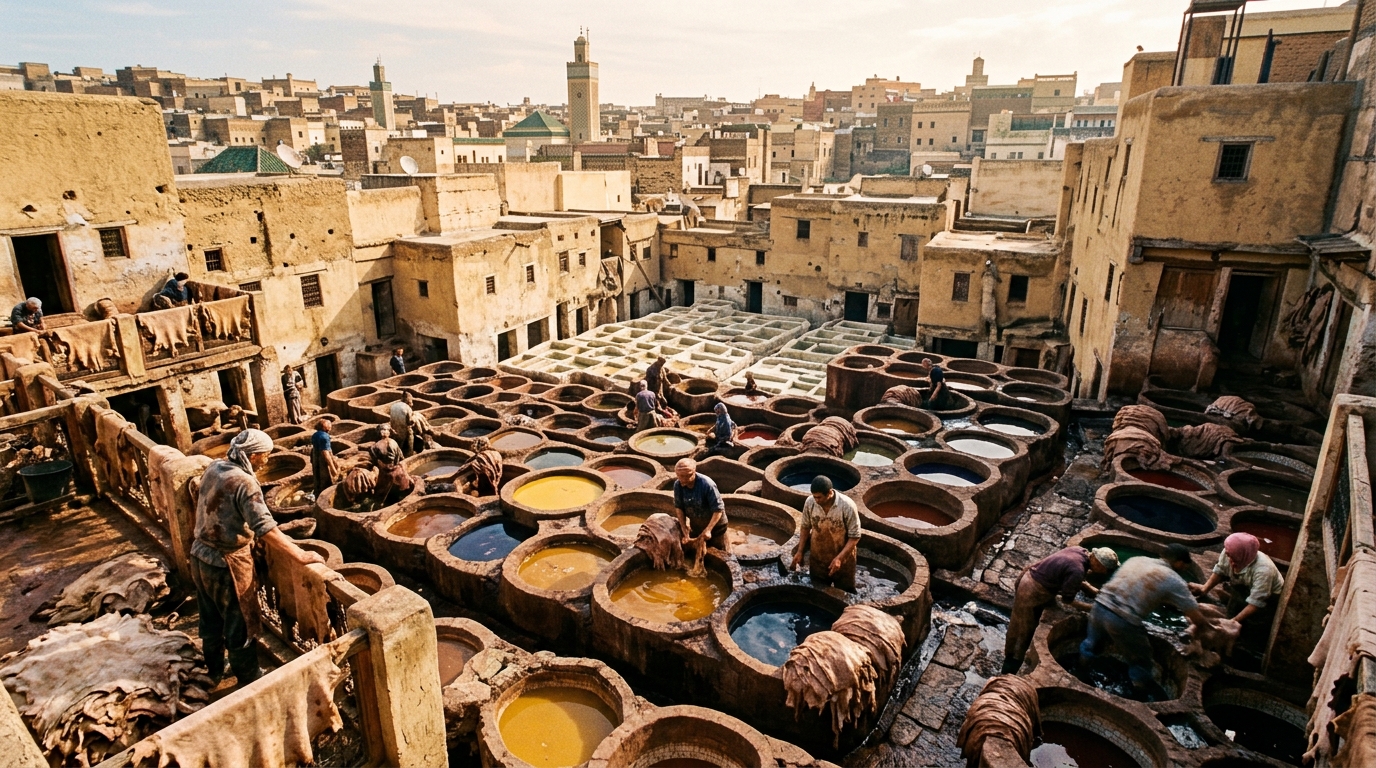
Dating to the 11th century, Chouara Tannery is one of Fes’s most iconic sights. Here, raw cow, sheep, goat, and camel hides are cured in hundreds of round stone vats filled with natural mixtures of water, pigeon droppings (rich in ammonia, used to soften the leather), quicklime, and salt. Once softened, the hides are submerged in vats of natural vegetable dyes: saffron and turmeric for yellow, poppy for red, indigo for blue, and cedar wood for brown.
- How to Visit: Because the tannery floor is an active, hazardous work environment, visitors view the vats from the rooftop terraces of surrounding multi-story leather goods shops. Leather shop attendants will hand you a sprig of fresh mint at the entrance to hold under your nose to mask the pungent odor of curing hides.
- Admission: Viewing from shop terraces is technically free, but shopkeepers expect a small tip (10–20 MAD / $1–$2 USD) if you do not purchase leather goods. If you intend to buy a jacket or leather bag, negotiate firmly—initial quotes are typically inflated by 60% to 70%.
2. University of al-Qarawiyyin
Founded in 859 AD by a wealthy refugee merchant woman named Fatima al-Fihri, the al-Qarawiyyin Mosque and University is recognized by UNESCO and the Guinness Book of World Records as the oldest continuously operating institution of higher learning in the world. Leading medieval scholars in mathematics, astronomy, and theology studied here, including the philosopher Ibn Rushd (Averroes) and Jewish scholar Maimonides.
- Visitor Access: As an active religious sanctuary, non-Muslims cannot enter the mosque interior. However, visitors can view the vast central courtyard through its grand arched cedar doorways along the main alleyway, catching glimpses of its intricately carved marble fountains, tiled colonnades, and prayer halls.
3. Al-Attarine Madrassa & Bou Inania Madrassa
Two exceptional 14th-century student colleges built under the Merenid dynasty showcase the peak of medieval Moroccan craftsmanship:
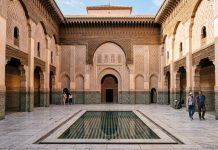
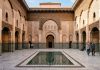
- Al-Attarine Madrassa: Located adjacent to the spice souk, this compact theological college features delicate cedar woodwork, glazed zellij mosaics, and carved marble columns framing a sunlit central courtyard. (Admission: 20 MAD / $2 USD).
- Bou Inania Madrassa: Situated near the Blue Gate, Bou Inania is unique because it served simultaneously as a residential student college and an official congregational mosque, complete with its own green-tiled minaret. It is one of the very few functioning religious buildings in Morocco open to non-Muslim visitors. (Admission: 20 MAD / $2 USD).
4. Bab Bou Jeloud (The Blue Gate)
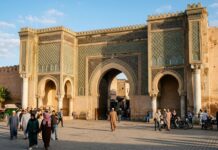
Constructed in 1913 under the French protectorate, Bab Bou Jeloud is the primary grand western entry gate into Fes el-Bali. The gate features three symmetrical horseshoe arches covered in blue glazed ceramic tiles on the exterior (the historic color of Fes) and green tiles on the interior (symbolizing Islam). The pedestrian plaza just inside the gate is filled with outdoor cafes and serves as the medina’s primary meeting point.
5. Borj Nord & The Merenid Tombs (Sunset Vantage Point)
For a complete perspective on the sheer scale of the medieval city, take a 10-minute Petit Taxi ride north of the medina walls to the hillside ruins of the Merenid Tombs or the 16th-century fortress of Borj Nord.
Arrive 30 minutes before dusk. From this elevated ridge, you can look down across the entire bowl-shaped medina of Fes el-Bali as hundreds of green minarets pierce the skyline and the synchronized evening call to prayer echoes across the valley.
Medina Navigation & Street Logistics
Navigating Fes el-Bali is significantly more challenging than navigating Marrakech due to its steep topography, covered passageways, and high stone walls that block mobile GPS signals:
- Understand the Two Spine Arteries: Starting from Bab Bou Jeloud, two parallel commercial thoroughfares run downhill through the medina: Tala’a Kebira (“The Big Slope”) and Tala’a Seghira (“The Little Slope”). Both eventually lead to the al-Qarawiyyin mosque and the tanneries at the bottom of the valley. Walking downhill takes you deeper into the medina; walking uphill brings you back toward the Blue Gate.
- Hire an Official Licensed Guide for Your First Morning: Unlike unofficial street hustlers, certified municipal guides wear official metal badges around their necks. Booking a licensed guide through your riad costs 300 to 450 MAD ($30–$45 USD) for a 4-hour tour. A guide provides critical architectural context and completely insulates you from street touts and persistent shop vendors.
- Yield to Working Pack Animals: Motorbikes are strictly banned inside Fes el-Bali (unlike Marrakech). Trash collection, food distribution, and construction supplies are transported entirely on the backs of mules and donkeys. When you hear the cry “Balak!”, step immediately against the nearest wall.
Transportation & Getting Around Fes
Airport Transit (FEZ to City)
- Grand Taxi: A flat municipal rate of 120 to 150 MAD ($12–$15 USD) applies for the 25-minute drive between Fes-Saïss Airport and the medina gates (Bab Bou Jeloud or Place R’cif).
- Bus Line 16: City bus Line 16 operates between the airport terminal and the Fes-Ville train station in the modern district every 45–60 minutes. Fare is 4 MAD ($0.40 USD). From the station, take a metered Petit Taxi to the medina (10–15 MAD).
Train & Bus Connections
- ONCF Rail: Direct trains depart Fes-Ville station multiple times daily:
- Fes to Rabat: 2 hours 45 minutes (~85 MAD)
- Fes to Casablanca: 3 hours 45 minutes (~115 MAD)
- Fes to Marrakech: 7 hours (~195 MAD)
- Fes to Tangier: 4 hours 15 minutes (~110 MAD)
- CTM Long-Distance Buses: The dedicated CTM bus terminal in Ville Nouvelle operates direct daily coach services to Chefchaouen (approx. 4 hours, 75 MAD) and south to Merzouga in the Sahara Desert (approx. 8.5–9 hours, 200 MAD).
Top Day Trips from Fes
- Volubilis & Meknes (1 hour): Take the morning train to Meknes, then hire a Grand Taxi to the UNESCO World Heritage Roman ruins of Volubilis. Explore remarkably preserved 2nd-century Roman mosaics, a triumphal arch, and olive presses overlooking rolling wheat plains. Pair this with a visit to the whitewashed holy pilgrimage town of Moulay Idriss Zerhoun.
- Bhalil & Sefrou (45 minutes): Located in the Middle Atlas foothills south of Fes. Sefrou was historically a center of Berber Jewish coexistence, known for its walled medina and cherry harvest. Nearby Bhalil is famous for historic cave dwellings carved directly into limestone cliffs, many still inhabited by local families.
- Middle Atlas Cedar Forests (Azrou & Ifrane, 75 minutes): Escape into the alpine Middle Atlas mountains to walk among century-old cedar trees in the Cèdre Gouraud forest, home to wild Barbary macaque monkeys.
Next Steps for Planning
To prepare your daily budget, review our detailed Morocco travel cost guide, learn what to pack for uneven cobblestones in our Morocco packing checklist, or see how Fes fits into a broader route in our 10-day Morocco itinerary.