
Marrakech offers far more than souvenir shopping in the central markets. Behind the high pink-clay mud walls of the medina lie centuries-old theological colleges, royal mausoleums adorned in imported Italian marble, restored Islamic botanical gardens, and world-class collections of North African photography.
To experience the city properly, plan your sightseeing strategically: visit enclosed historical palaces early in the morning before tour bus crowds arrive, escape to modern garden districts during the midday heat, and head into the high-traffic squares as dusk settles. Here are the 15 best things to do in Marrakech, complete with exact ticket prices, location advice, and practical visiting tips.
Marrakech Top Attractions Summary
| Attraction | Location | Admission Fee | Recommended Duration | Advance Booking? |
|---|---|---|---|---|
| Ben Youssef Madrassa | Northern Medina | 50 MAD ($5.00) | 45–60 min | No (pay at door) |
| Bahia Palace | Southern Medina | 70 MAD ($7.00) | 60–90 min | No (pay at door) |
| Saadian Tombs | Kasbah District | 70 MAD ($7.00) | 30–45 min | No (pay at door) |
| Badi Palace | Kasbah District | 70 MAD ($7.00) | 60 min | No (pay at door) |
| Jardin Majorelle & YSL Museum | Gueliz | 150–220 MAD ($15–$22) | 90–120 min | Yes (Online Only) |
| Maison de la Photographie | Medina (near Ben Youssef) | 50 MAD ($5.00) | 45 min | No (pay at door) |
| Le Jardin Secret | Mouassine / Medina | 100 MAD ($10.00) | 45–60 min | No (pay at door) |
| Jemaa el-Fna Sunset Terrace | Central Square | Price of drink (20–30 MAD) | 60 min | No (arrive by 5:30 PM) |
| Traditional Hammam | Various | 120–800 MAD ($12–$80) | 60–90 min | Yes for private spas |
| Moroccan Cooking Class | Medina Riads | 350–550 MAD ($35–$55) | 3–4 hours | Yes (1–2 days ahead) |
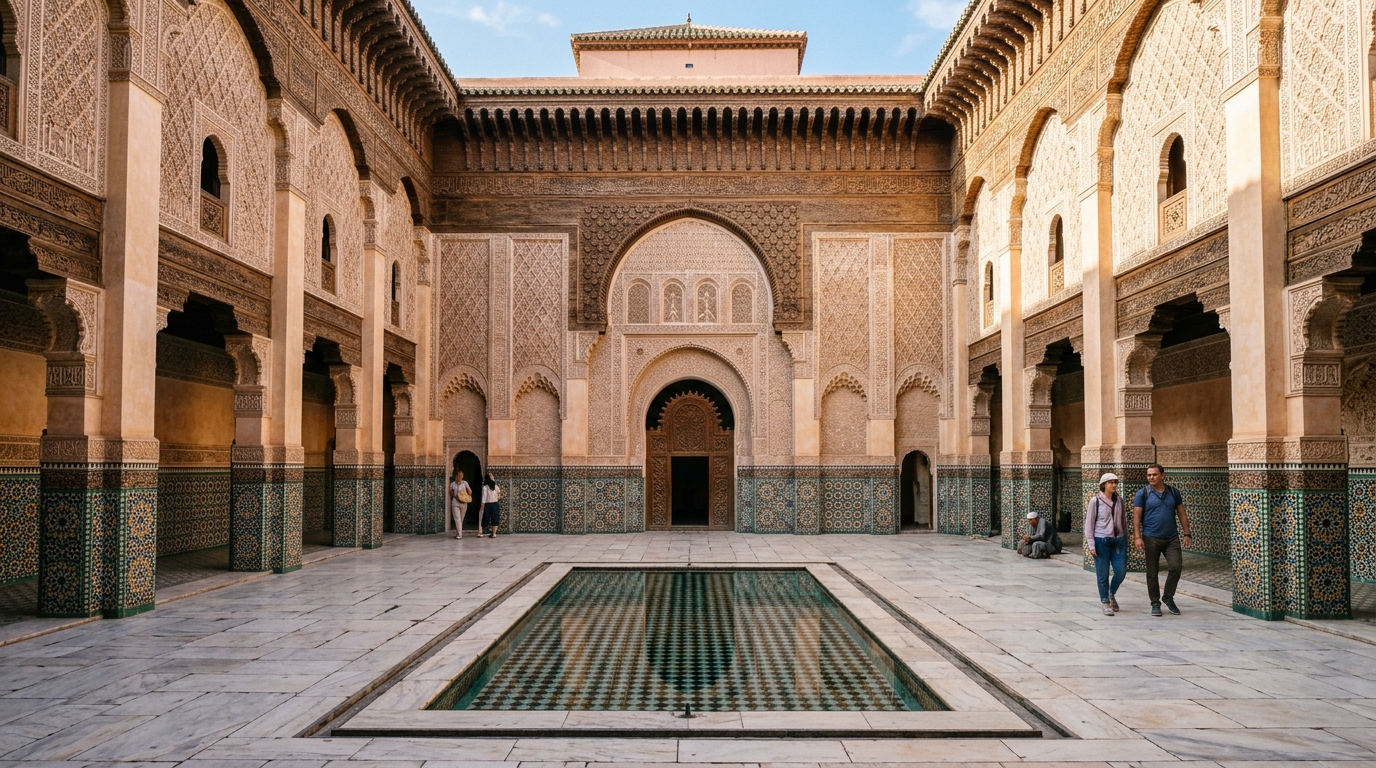
1. Marvel at the Craftsmanship of Ben Youssef Madrassa
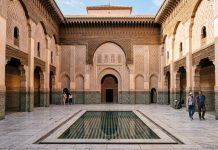
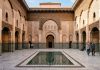
Originally founded in the 14th century and reconstructed in 1565 under the Saadian Sultan Abdallah al-Ghalib, the Ben Youssef Madrassa was once the largest Islamic theological college in North Africa, accommodating over 900 Quranic and legal scholars. Reopened following an extensive multi-year restoration, its central courtyard is a pinnacle of Moroccan decorative art.
Walk the perimeter of the shallow marble reflecting pool to inspect hand-chiseled stuccowork featuring Quranic inscriptions in Kufic script, intricate geometric zellij tile dados, and carved Atlas cedar lintels. Climb the narrow tile stairs to the second floor to explore the 130 compact student dormitory cells overlooking inner lightwells.
- Insider Tip: Arrive at 9:00 AM sharp when the entrance opens. By 10:15 AM, organized tour groups fill the central courtyard, making wide-angle architectural photography difficult.
- Cost: 50 MAD (~$5.00 USD).
2. Tour the Grand Courtyards of Bahia Palace
Built in two phases during the late 19th century by Grand Vizier Si Moussa and his son and successor Ba Ahmed (regent for the young Sultan Moulay Abdelaziz), the Bahia Palace (“The Palace of the Brilliant”) spans eight hectares of labyrinthine courtyards, staterooms, and lush interior gardens planted with bitter orange and cypress trees.
Highlights include the vast Grand Courtyard paved in Italian Carrara marble, surrounded by a yellow-and-blue wooden colonnade, and the private residential apartments of Ba Ahmed’s four wives, featuring hand-painted cedar ceilings with botanical motifs. While the palace was stripped of its furniture following Ba Ahmed’s death in 1900, the architectural finishes remain intact.
- Cost: 70 MAD (~$7.00 USD).
- Timing: Allow 60 to 90 minutes; pair this visit with the nearby Mellah or Badi Palace.
3. Step Inside the Royal Saadian Tombs
Located behind the 12th-century Kasbah Mosque in the southern medina, the Saadian Tombs serve as the final resting place of Sultan Ahmad al-Mansur and sixty members of the Saadian dynasty who ruled during Morocco’s 16th-century golden age.
The centerpiece is the Chamber of the Twelve Pillars, where Sultan al-Mansur and his sons are interred beneath elaborately vaulted muqarnas (honeycomb) ceilings carved from cedar and plaster, supported by columns of imported Italian Carrara marble. The Alaouite Sultan Moulay Ismail sealed the necropolis behind high defensive walls in the 17th century to erase his predecessors’ legacy, leaving it forgotten until French aerial cartographers spotted it in 1917.
- Cost: 70 MAD (~$7.00 USD).
- Tip: The viewing portal into the Chamber of the Twelve Pillars allows only two or three visitors to look in at a time. Expect a 15-minute queue during peak afternoon hours.
4. Walk the Stork-Lined Ruins of Badi Palace
In stark contrast to the intact decorative tilework of Bahia Palace, the Badi Palace (“The Incomparable”) is a monumental ruin. Commissioned in 1578 by Sultan Ahmad al-Mansur to celebrate his victory over the Portuguese army at the Battle of the Three Kings, it was funded by Portuguese ransom gold and originally finished in Italian marble, Irish granite, and gold leaf.
When the Alaouite dynasty seized power a century later, Sultan Moulay Ismail spent twelve years stripping the palace of its materials to construct his new imperial capital at Meknes. Today, visitors walk through vast sunken orange orchards surrounded by towering rammed-earth (pisé) walls topped by dozens of nesting white storks. Descend into the subterranean tunnels that once served as storerooms and royal prisons.
- Cost: 70 MAD (~$7.00 USD).
- Highlight: The site houses the 12th-century wooden Minbar (prayer pulpit) of the Koutoubia Mosque, crafted in Cordoba, Spain.
5. Watch Jemaa el-Fna Transform from a Rooftop Terrace
Marrakech’s central square, Jemaa el-Fna, changes personality completely around dusk. The best way to absorb this transition without dealing with aggressive street performers or henna hawkers is from a second-story rooftop cafe terrace.
Head to Café de France or Le Grand Balcon du Café Glacier by 5:30 PM (or roughly 45 minutes before sunset). Order a pot of hot Moroccan mint tea (20–30 MAD) and secure a front-row balcony table. From above, you can watch the sunset turn the sky violet behind the 12th-century Koutoubia minaret as dozens of open-air food stalls light their charcoal braziers and billowing smoke rises over the plaza.
6. Navigate the Specialized Artisan Souks
The medina souks north of Jemaa el-Fna are organized historically by guild and craft tradition. Rather than wandering aimlessly, seek out specific artisan districts where master craftsmen produce goods on-site:
- Souk Haddadine: The blacksmiths’ quarter. Listen for the sound of hammers striking anvils as craftsmen forge ornate wrought-iron lanterns, fire screens, and hardware.
- Souk Cherratine: The leatherworkers’ street. Stalls produce hand-stitched leather duffel bags, belts, saddlebags, and traditional pointed slippers (babouches).
- Rahba Kedima (The Spice Square): An open triangular plaza where merchants stack conical pyramids of culinary spices (saffron, cumin, paprika, ras el hanout) alongside medicinal dried eucalyptus, black cumin, and amber perfume blocks.
- Souk des Teinturiers: The dyers’ souk, where freshly dyed skeins of wool and silk hang overhead from bamboo poles to dry in the afternoon sun.
7. Visit Jardin Majorelle & The Yves Saint Laurent Museum
Located in the modern neighborhood of Gueliz, Jardin Majorelle was created over forty years by French painter Jacques Majorelle, who framed exotic cacti, bamboo groves, and water lily pools against an electric cobalt-blue Art Deco villa. In 1980, fashion icon Yves Saint Laurent and partner Pierre Bergé bought and restored the garden.
Directly adjacent is the Musée Yves Saint Laurent Marrakech, a stunning terracotta brick building housing rotating exhibitions of Saint Laurent’s haute couture work, inspired by Moroccan colors and textiles, along with an auditorium and research library.
- Crucial Booking Rule: Tickets are no longer sold at the entrance gate. You must purchase timed digital tickets in advance via the official site (jardinmajorelle.com) several days ahead during peak spring and autumn travel seasons.
- Admission: 150 MAD for Jardin Majorelle; 220–300 MAD for combined museum access.
8. Experience an Authentic Moroccan Hammam
A hammam is a traditional public steam bath that forms an essential part of weekly Moroccan social life. The ritual involves steaming in heated tiled chambers, washing with savon noir (black eucalyptus olive-oil soap), and receiving an invigorating full-body exfoliation with an abrasive kessa glove.
- Authentic Neighborhood Hammams: Visit historic neighborhood baths like Hammam Mouassine (operating since 1562). Men and women have separate hours or facilities. Entry costs 15–20 MAD ($1.50–$2.00), plus 50–70 MAD for an attendant scrub (tiyaba/kiyas). Bring your own soap, towel, flip-flops, and a small tip.
- Boutique Tourist Spas: For private rooms, fluffy bathrobes, and scented argan oil massages, book a session at establishments like Les Bains de Marrakech, Heritage Spa, or Hammam de la Rose. Expect to pay 400 to 900 MAD ($40–$90 USD) for a 90-minute treatment.
9. Admire Vintage Prints at Maison de la Photographie
Housed in a beautifully restored three-story riad near Ben Youssef Madrassa, the Maison de la Photographie exhibits an exceptional private archive of vintage photography, glass plates, and early documentary footage of Morocco captured between 1870 and 1950.
The collection provides invaluable historical context, showcasing the tribal costumes of High Atlas Amazigh communities and street life in Marrakech before modern development. The top-floor rooftop terrace is one of the highest in the northern medina, serving fresh mint tea, fresh orange juice, and light lunches with panoramic views toward the Atlas Mountains.
- Cost: 50 MAD (~$5.00 USD).
10. Take a Hands-On Moroccan Cooking Class
Moroccan cooking relies on complex layering of spices, slow steam braising, and preserved fruits. Several reputable medina cooking schools (such as La Maison Arabe, Atelier Chef Tarik, or Amal Non-Profit Center) run half-day workshops:
- The Experience: Most classes begin with a guided walk through neighborhood food markets to buy fresh cilantro, preserved lemons, and vegetables. Back in the kitchen, instructors guide you through preparing traditional bread, an authentic lamb or chicken tajine, and dessert pastilla.
- Cost: 350 to 550 MAD ($35–$55 USD) per person, including your multi-course lunch.
- Tip: Booking with the Amal Center supports their non-profit mission training disadvantaged Moroccan women in culinary careers.
11. Ride a Hot Air Balloon Over the Atlas Foothills at Sunrise
For a complete perspective on Morocco’s landscape, operators like Ciel d’Afrique run sunrise hot air balloon flights over the arid plains and Berber hamlets surrounding Marrakech. You depart your riad before dawn (around 5:00 AM) to watch the balloons inflate against the sunrise, followed by an hour of silent gliding with the snowcapped High Atlas peaks on the horizon.
- Cost: 2,050 to 2,500 MAD ($205–$250 USD) per person, including 4×4 round-trip hotel transfers and a post-flight Berber breakfast in a desert tent.
12. Unwind in Le Jardin Secret
Hidden behind high medina walls in the Mouassine district, Le Jardin Secret is a restored 19th-century palace complex formerly owned by influential political leaders of the High Atlas. Restored by Italian architect Tommaso Buzzi, the property features two distinct gardens:
- The Islamic Garden: Laid out in a traditional four-part Chahar Bagh design, symbolizing the four rivers of paradise described in the Quran. It is fed by a restored historic underground water system (khettara) originating in the Atlas Mountains.
- The Exotic Garden: Filled with desert succulents, cacti, and flora gathered from Australia, Madagascar, and South Africa.
- Cost: 100 MAD (~$10.00 USD). It provides a peaceful, quiet escape from the medina crowds.
13. Explore the Historic Mellah (Jewish Quarter)
Established in 1558 by the Saadian dynasty south of the royal palaces, Marrakech’s Mellah was once an enclosed Jewish residential quarter where artisans specialized in jewelry making, brass casting, and banking. While most of the Jewish population relocated in the mid-20th century, the neighborhood retains distinct architectural features with outward-facing balconies and wooden shutters uncommon in the Muslim medina.
Visit the Slat al-Azama Synagogue, operating continuously since 1492 following the expulsion of Sephardic Jews from Spain, featuring a central blue-tiled courtyard and museum exhibits on Moroccan Jewish heritage. Nearby, walk through the whitewashed Miara Jewish Cemetery, the largest Jewish burial ground in Morocco.
14. Hike Through Berber Valleys in Imlil
When the medina feels overwhelming, take a day trip to the mountain hamlet of Imlil (elevation 1,740 meters), nestled at the foot of Mount Toubkal in the High Atlas Mountains. Located just 90 minutes south of Marrakech by Grand Taxi (fare approx. 300–400 MAD for a private taxi, or 40 MAD per seat in a shared cab from Bab er-Rob):
- The Walk: A gentle 2-hour loop trail climbs along terraced walnut orchards and rushing mountain streams up to the village of Aroumd. Enjoy lunch (warm vegetable tajine and fresh bread) on a guesthouse rooftop terrace with dramatic mountain panoramas before returning to Marrakech by late afternoon.
15. Dine Under the Stars in the Agafay Desert
If your itinerary does not allow for the full 9-hour drive to the sand dunes of the Sahara Desert, the Agafay Desert is a rocky, moon-like limestone plateau located just 45 minutes southwest of Marrakech.
Numerous boutique desert camps (such as Scarabeo Camp, Inara Camp, and Terre des Etoiles) offer sunset day passes. You can take a 45-minute camel trek along arid ridges, watch the sun set over the stony desert hills, and enjoy a candlelit outdoor dinner with live acoustic gnawa music and stargazing around an open bonfire before driving back to the city.
Next Steps for Planning Your Marrakech Stay
For neighborhood hotel suggestions and airport transport logistics, read our primary Marrakech Travel Guide, calculate your daily expenses with our Morocco trip cost breakdown, and review modest clothing etiquette in our guide on what to wear in Morocco.