
Casablanca is Morocco’s largest city, primary economic engine, and international air travel gateway. With a metropolitan population exceeding four million people, it operates at a modern, commercial tempo fundamentally different from the medieval medinas of Fes or the tourism-focused riads of Marrakech.
Most international travelers arrive via Casablanca Mohammed V Airport (CMN) and quickly board a train elsewhere. However, spending 24 to 36 hours in Casablanca offers substantial rewards: the monumental Hassan II Mosque rising directly over the Atlantic Ocean, one of the world’s most dense concentrations of early 20th-century Mauresque and Art Deco architecture, and the peaceful, stone-arched Habous Quarter. This guide outlines how to plan an efficient visit, navigate the city’s dual railway stations, and explore its key sights.
Casablanca Fast Facts for Travelers
- Airport: Mohammed V International Airport (CMN), located 30 km south of the city center
- Primary Train Stations: Casa-Voyageurs (High-Speed Al Boraq hub) and Casa-Port (downtown waterfront station)
- City Taxi Color: Red Petit Taxis
- Recommended Stay: 1 to 2 days (ideal as an arrival or departure stop)
- Best Seasons: May to October (temperate Atlantic ocean climate)
The Crown Jewel: Visiting the Hassan II Mosque
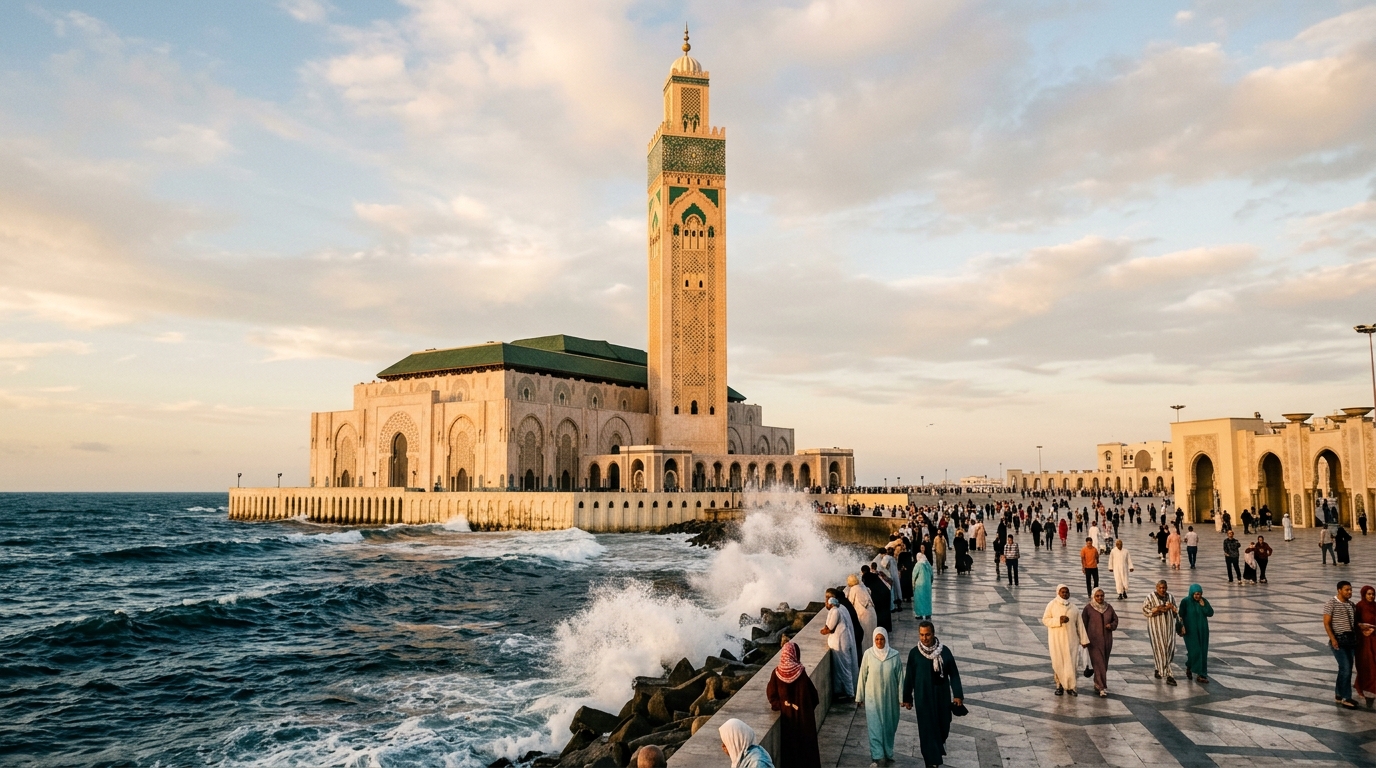
Completed in 1993 after six years of construction involving over 10,000 artisans, the Hassan II Mosque is one of the largest mosques in the world and an extraordinary testament to Moroccan craft traditions. Designed by French architect Michel Pinseau, the complex sits on a rocky platform projecting directly into the Atlantic Ocean, reflecting the Quranic verse stating that “the throne of God was built upon the water.”
Key Mosque Facts
- The Minaret: Rises 210 meters (689 feet), making it one of the tallest minarets on earth. At night, a directional green laser projects 30 kilometers from the summit toward Mecca.
- The Prayer Hall: Accommodates 25,000 worshippers inside, with space for an additional 80,000 on the outdoor marble esplanade. Features a motorized 1,100-ton cedar roof that slides open in three minutes for open-air ventilation.
- Craftsmanship: The interior features hand-chiseled stuccowork, carved Atlas cedar, polished Carrara marble columns, and subterranean ablution halls with 41 marble lotus fountains.
Visitor Rules & Tour Logistics
Unlike almost all other functioning mosques in Morocco, the Hassan II Mosque is open to non-Muslim visitors through scheduled, structured guided tours conducted in English, French, Spanish, and German.
- Tour Timings: Saturday through Thursday tours typically run at 9:00 AM, 10:00 AM, 11:00 AM, 12:00 PM, 3:00 PM, and 4:00 PM. On Fridays, morning tours are suspended or altered for midday congregational prayers (Jumu’ah). Confirm current hours at the on-site ticketing office.
- Admission: 130 MAD (~$13.00 USD) for adults; 65 MAD for students. Tickets can be purchased at the subterranean museum and visitor center on the mosque grounds.
- Etiquette & Dress Code: Knees and shoulders must be covered for both men and women. Shoes must be removed before entering the carpeted prayer hall; staff provide plastic bags to carry your shoes with you during the tour.
Exploring Beyond the Mosque: Top Things to Do
1. Stroll the Habous Quarter (The “New Medina”)
Constructed in the 1920s by French colonial urban planners seeking to house rural migrants, the Habous Quarter (Quartier Habous) is a unique architectural hybrid blending French civic planning with traditional Moroccan stone arches, arcaded walkways, and small green plazas.
- Marché aux Olives: A small walled courtyard where dozens of merchants display large barrels of cured olives marinated in harissa, preserved lemon, herbs, and garlic.
- Pâtisserie Bennis Habous: Founded in 1930, this legendary family bakery on Rue Fkih El Gabbas produces some of the finest traditional Moroccan pastries in the country, including freshly baked cornes de gazelle (almond paste pastries scented with orange blossom water) and crispy pastilla.
- Mahkama du Pacha: A historic municipal courthouse and reception hall containing over sixty richly decorated chambers adorned in carved cedar, Italian marble, and elaborate zellij tilework. (Access is occasionally restricted for official government use; hire an official local guide at the gate for entry assistance).
2. Downtown Art Deco & Mauresque Walking Route
During the French protectorate in the early 20th century, European architects used Casablanca as an open-air testing ground for avant-garde urban architecture, creating the Mauresque style—a distinctive blend of Art Nouveau and Art Deco geometry with traditional Moroccan horseshoe arches, zellij mosaics, and carved cedar balconies.
Walk along Boulevard Mohammed V and Rue Idriss Lahrizi to view key architectural landmarks:
- Place Mohammed V: The civic heart of French Casablanca, anchored by the Wilaya (administrative palace) with its 50-meter clock tower, the Palais de Justice, and the contemporary Grand Théâtre de Casablanca.
- Cinema Rialto: An iconic 1930 Art Deco cinema hall where Josephine Baker and Edith Piaf once performed.
- Hotel Lincoln Facade: A landmark 1916 neo-Moorish structure along Boulevard Mohammed V, currently undergoing historic restoration.
3. Walk the Atlantic Corniche in Ain Diab
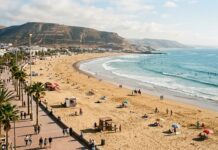
Located west of the Hassan II Mosque, the coastal neighborhood of Ain Diab features a wide, modern seaside promenade running along the Atlantic Ocean. The strip is lined with private beach clubs, saltwater swimming pools, modern cafes, and upscale seafood restaurants. It is an ideal spot for a late afternoon oceanfront stroll as local families gather to watch the Atlantic waves break against the rocky coast.
4. The Reality of Rick’s Café
The iconic 1942 film Casablanca starring Humphrey Bogart and Ingrid Bergman was filmed entirely on Warner Bros soundstages in Burbank, California; neither actor ever visited Morocco. However, in 2004, former American diplomat Kathy Kriger opened the real-world Rick’s Café inside a restored 1930s courtyard riad near the port walls.
The restaurant faithfully recreates the cinematic atmosphere with curved archways, brass table lamps, palm plants, a central 1930s Pleyel baby grand piano playing “As Time Goes By,” and the movie playing on a continuous loop in an upstairs lounge. It is popular for upscale evening cocktails and fresh Atlantic seafood.
- Reservations: Essential for dinner; book several days ahead via their official website (rickscafe.ma).
- Dress Code: Strictly enforced smart casual (no shorts, tank tops, or sandals for dinner).
Casablanca Transportation & Rail Stations
Airport Transit: Mohammed V Airport (CMN) to Downtown
The fastest, cheapest, and most reliable way to travel between Mohammed V Airport and central Casablanca is the Al Bidaoui airport shuttle train:
- Location: The train station is located directly in the basement of Terminal 1 (follow the “Gare / Train” signs from arrivals).
- Schedule: Trains depart roughly every hour from 4:00 AM to 10:00 PM.
- Travel Time: 35 minutes to Casa-Voyageurs; 45 minutes to Casa-Port.
- Cost: 50 MAD (~$5.00 USD) in second class (vs. 250–350 MAD for an official airport taxi).
Understanding the Two Central Rail Stations
Casablanca has two primary passenger rail hubs operated by ONCF:
- Casa-Voyageurs: Located 3 km east of downtown. This is the primary transfer junction for the Al Boraq high-speed train to Rabat (50 minutes) and Tangier (2 hours 10 minutes), as well as conventional express lines to Marrakech (2 hours 40 minutes) and Fes (3 hours 45 minutes).
- Casa-Port: Located downtown directly beside the harbor and the Old Medina. This modern, multi-level station handles coastal commuter routes to Rabat, Kenitra, and airport connections.
City Taxis & Tramway
- Red Petit Taxis: Abundant throughout the city. Always insist that the driver switch on the mechanical meter (le compteur). Base fare starts at 2.50 MAD with a minimum fare of 7.50 MAD. A ride across town rarely exceeds 20 to 30 MAD.
- Casablanca Tramway: Two modern tram lines (T1 and T2) connect Casa-Voyageurs, downtown, and the Ain Diab beach promenade. Tickets cost 8 MAD per ride and provide an efficient way to avoid notorious rush-hour traffic.
Next Steps for Planning Your Morocco Route
From Casablanca, most travelers connect north via the high-speed Al Boraq train to explore the blue alleys in our Chefchaouen Travel Guide, head inland using our Fes Travel Guide, or travel south to the souks using our Marrakech Travel Guide.