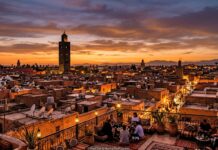

Choosing where to sleep in Marrakech shapes your entire trip. The city divides between the dense, walled medieval medina and the twentieth-century French colonial districts of Gueliz and Hivernage, with resort compounds spreading further into the Palmeraie. Your base determines how you wake up each morning, whether you navigate pedestrian alleyways on foot or hail cabs outside wide boulevards, and how you manage street noise, luggage, and midday heat.
Travelers often arrive expecting candlelit courtyards and rose-petal baths, only to encounter narrow walking alleys, steep tiled stairs without elevators, and the sound of morning prayers echoing over plaster walls at 5:00 AM. Others book generic hotel rooms in the new city to avoid logistical friction, only to spend significant time and taxi fares commuting back into historic quarters. Understanding how these properties function and what daily life inside them entails ensures you choose the right accommodation for your travel style.
Anatomy of a riad vs dar vs modern hotel
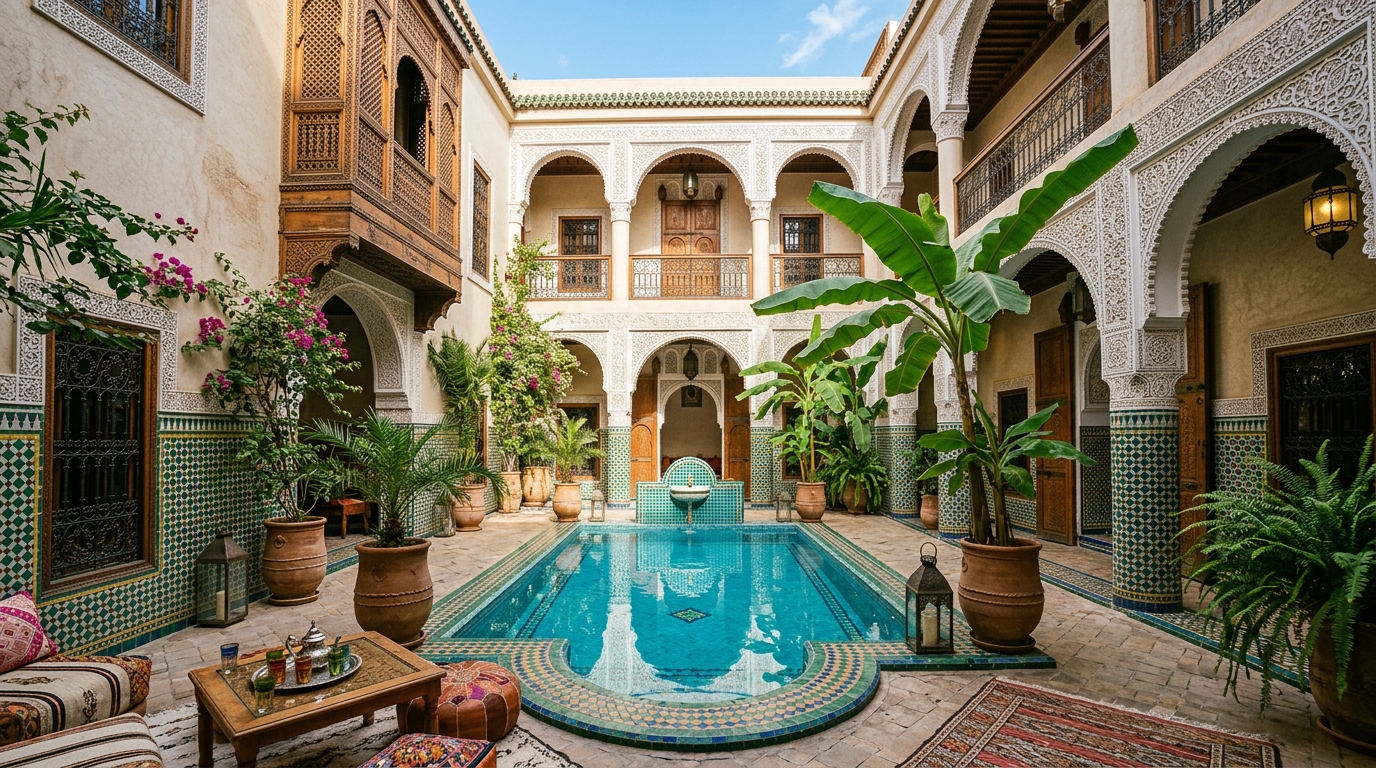
The word riad comes from the Arabic riyad, meaning garden. Historically, a riad was a stately urban townhouse organized around an interior garden courtyard, often featuring four planted quadrants with fruit trees and a central stone water fountain. A dar (meaning house) follows an inward-facing design centered on a smaller, tiled patio without planted trees. In modern travel usage, the term riad describes almost any restored guesthouse inside the historic city walls, yet their construction remains fundamentally different from conventional hotels.
Traditional Moroccan domestic architecture looks inward. Exterior street walls are plain, windowless mud-brick or baked clay (pisé), built to protect family privacy, preserve security, and shield living quarters from intense summer sun. Stepping through a low doorway reveals an open-air central courtyard surrounded by ground-floor reception salons. Guest rooms occupy upper galleries looking down over the courtyard fountain, while flat rooftops function as sun terraces and breakfast areas.
This inward-facing layout creates an intimate setting with clear practical distinctions compared to standard chain hotels:
- Room capacity: Most riads have four to ten rooms. Staff members learn your name and daily plans quickly. Modern hotels in Gueliz or Hivernage house hundreds of guests, providing anonymous service, elevators, and 24-hour reception desks.
- Windows and light: Because rooms face inward onto the patio rather than outward onto the street, lower-floor rooms rely on indirect daylight. Travelers who require open street views may find inward-facing rooms dim.
- Plaster and tile finishes: Bathrooms feature hand-smoothed lime plaster called tadelakt, polished with river stones and black soap, paired with geometric ceramic tilework (zellige). Showers often open directly into wet-room floors without separate glass stalls.
- Acoustic reality: The open atrium serves as the lounge, breakfast room, and primary hallway. Sound carries directly from courtyard tables up to bedroom doors.
| Property Type | Average Price (MAD) | Average Price (USD) | Typical Room Count | Best Suited For |
|---|---|---|---|---|
| Budget Guesthouse / Dar | 300 to 600 MAD | $30 to $60 | 3 to 6 rooms | Backpackers and independent travelers wanting simple, clean rooms. |
| Mid-Range Boutique Riad | 700 to 1,600 MAD | $70 to $160 | 5 to 10 rooms | First-time visitors wanting traditional architecture and attentive hosts. |
| Luxury Riad / Palace | 2,000 to 6,500+ MAD | $200 to $650+ | 6 to 15 suites | Travelers seeking private hammams, heated pools, and fine dining. |
| Modern City Hotel (Gueliz) | 550 to 1,200 MAD | $55 to $120 | 50 to 200 rooms | Business travelers and visitors requiring elevators or road access. |
| Luxury Resort (Hivernage / Palmeraie) | 4,500 to 18,000+ MAD | $450 to $1,800+ | 100 to 300 rooms | Resort guests prioritizing expansive swimming pools, golf, and quiet grounds. |
Moroccan accommodations also collect the municipal tourist tax, known locally as the Taxe de Séjour or TSPT. This levy ranges between 25 and 35 MAD ($2.50 to $3.50 USD) per guest per night. Booking engines rarely collect this fee during checkout, so keep cash dirhams ready to pay upon departure.
Neighborhood comparison: where to base yourself
Marrakech divides into distinct residential districts, each with its own transit access, noise profile, and walking conditions.
The Medina: central quarters for historic atmosphere
Sleeping within the ramparts puts you steps from historical landmarks, artisan workshops, and food stalls. The medina is large, and conditions vary by district:
- Mouassine and Bab Ksour: Positioned along the western flank of the central souks, these quarters rank among the most convenient areas in the old city. They offer restored boutique riads, well-maintained stone paving, evening street lamps, and direct walking access to both Jemaa el-Fna and taxi drop-off gates at Bab Ksour.
- Bab Doukkala: Situated on the northwestern rim of the medina, Bab Doukkala is an active residential quarter centered on a food market street. It features affordable dars, local bakeries, and immediate proximity to city bus routes and Petit Taxi ranks.
- The Kasbah: Located in the southern medina near the Saadian Tombs, the Kasbah has broader alleys, better sightlines, and fewer street touts than the central market alleys. Taxis can drive deeper into Kasbah squares, which helps travelers carrying heavy bags.
- Kennaria and Dabachi: East of Jemaa el-Fna, these dense streets put you within three minutes of the central square. Foot traffic is intense, motorbikes pass through narrow lanes, and street noise lasts past midnight.
Gueliz (Ville Nouvelle): modern roads and sidewalk cafes
Constructed by French urban planners during the early twentieth century, Gueliz follows a grid pattern with wide paved avenues, traffic lights, and sidewalks. Buildings consist of ochre apartment blocks housing fashion shops, bakeries, art galleries, and cafes.
Staying in Gueliz removes medina navigation stress. Taxis pull straight to hotel entrances, elevators carry luggage to your floor, and international restaurants are plentiful. Gueliz also contains the Marrakech central train station (Gare ONCF), grocery stores like Carrefour, and licensed wine shops. However, Gueliz lacks historic Moroccan architecture. Visiting the medina requires a 10 to 15-minute Petit Taxi ride (15 to 25 MAD) or a 30-minute walk along Avenue Mohammed V.
Hivernage: luxury avenues and calm hotels
South of Gueliz and west of the medina ramparts sits Hivernage, the city’s green hotel and residential district. Hivernage features palm-lined boulevards, quiet avenues, international five-star hotels (such as Sofitel, Four Seasons, and Mövenpick), cocktail lounges, and the Casino de Marrakech.
Hivernage suits visitors wanting full resort amenities, large outdoor swimming pools, wellness spas, and uninterrupted sleep. It lies between Gueliz and Jemaa el-Fna, placing both within a 20-minute walk or a brief taxi ride.
The Palmeraie: sprawling villa resorts
The Palmeraie is an expansive palm oasis several kilometers northeast of the city center. It contains private walled villas, golf resorts, and hotel compounds spread across thousands of date palms.
The Palmeraie offers quiet gardens, bird calls, and championship golf courses. However, you cannot walk to sights or restaurants outside your compound. Outings into the medina require arranging private hotel transfers or negotiating taxi fares of 100 to 150 MAD ($10 to $15 USD) each way. This district works best for travelers prioritizing poolside rest over active sightseeing.
On-the-ground medina realities: noise, stairs, and luggage
Staying in a medina riad involves specific physical realities that booking photographs do not show. Knowing what to expect prevents common frustrations.
The luggage journey and medina porters
Taxis and buses cannot drive into pedestrian medina lanes. Your driver will stop at the nearest accessible gate (bab) or public square and indicate the alley leading toward your address.
Local porters with two-wheeled wooden handcarts, called a karrousa or koussa, wait at drop-off gates to haul luggage over rough cobblestones. Agree on the price before placing your bags on the cart:
- For a short five-minute walk to a nearby alley, pay 20 to 30 MAD ($2.00 to $3.00 USD).
- For a walk of ten to fifteen minutes into deep residential derbs, pay 40 to 50 MAD ($4.00 to $5.00 USD).
- Keep small coins and notes ready so you can hand over exact change without disputes.
Most established riads will send a staff member to meet your taxi at the drop-off gate if you notify them of your arrival time 24 hours in advance.
Acoustics and the morning call to prayer
A riad functions like a vertical acoustic chimney lined with hard tiles and polished plaster. Sounds from the central patio travel straight up to guest rooms. When staff set tables or prepare coffee at 7:00 AM, dishes clatter and voices carry into bedrooms. Light sleepers should request an upper-floor room away from common areas and pack foam earplugs.
Neighborhood mosques broadcast the call to prayer (adhan) five times daily, starting with the dawn prayer (Fajr), which sounds between 4:45 AM and 6:00 AM depending on the season. Minaret loudspeakers are often mounted within a short distance of riad rooftops. The dawn prayer is part of daily Moroccan life, but it will wake light sleepers.
Stairs, elevators, and physical accessibility
Riads are historic private townhouses built over two or three vertical levels without elevators. Staircases are narrow, winding, and tiled with smooth ceramic zellige that becomes slippery when wet. Step risers are frequently steep and uneven. Travelers who use walking aids, have knee pain, or travel with young children should request a ground-floor room (chambre rez-de-chaussée) or choose a modern hotel in Gueliz with elevators.
Winter heating and summer cooling
Thick pisé clay walls provide natural insulation, keeping courtyards cooler than the street in hot weather. However, winter in Marrakech (December to February) brings nighttime temperatures down to 5°C to 8°C (41°F to 46°F). Unheated rooms become cold and damp. Confirm that your riad provides reverse-cycle heating units or a functioning fireplace in the salon.
In July and August, outdoor temperatures regularly climb past 42°C (108°F). Upper-level rooms trap afternoon heat, making air conditioning necessary. Courtyard plunge pools are small basins intended for a quick dip to cool off, not for swimming laps.
Night walking safety and navigating medina alleys
Concerns about walking through the medina at night are common among first-time visitors. The old town consists of busy commercial streets and quiet residential lanes called derbs. Main corridors like Rue Semmarine and Rue Riad Zitoun stay lit and populated past 11:00 PM with merchants and local families.
Turning into a residential derb changes the environment quickly. Derbs are narrow, framed by tall blank walls, and frequently covered with cedar beams that block out the night sky. While these alleys can feel forbidding, violent crime is rare. Neighbors know each other, and families monitor their street closely. Practical precautions help you navigate comfortably:
- Download an offline map on your smartphone before heading out. Google Maps frequently loses accuracy under covered alleyways. Maps.me and Organic Maps rely on OpenStreetMap data, which details pedestrian derbs accurately.
- Pin your riad entrance on your digital map before departing each morning.
- If someone on a street corner says “the street is closed,” do not stop. Reply with a polite “La, shukran” (No, thank you) and keep walking. Alleys connect normally unless visible masonry work is underway.
- Use your phone light to spot uneven stones and shallow drainage gutters in dimly lit corridors.
- If you ever feel lost after dinner, stop inside an open shop or cafe and call your riad. Staff will walk out to meet you at a recognizable landmark.
Breakfast and riad hospitality
A memorable element of riad stays is the morning meal (ftour). Instead of standard buffet trays, riad breakfasts are made to order and served in the courtyard or on the roof terrace.
Breakfast typically includes fresh orange juice, strong coffee, mint tea, warm flatbread (khobz), layered semolina flatbread (msemen), and honeycombed pancakes (baghrir). These arrive with honey, fruit jam, black olives, fresh goat cheese (jben), and eggs cooked with cumin or olive oil.
Riad managers also serve as on-site concierges. They arrange reliable transfers, suggest neighborhood bathhouses, book restaurant tables, and coordinate mountain day trips. Leaving a tip of 50 to 100 MAD ($5 to $10 USD) per day of your stay in the shared tip box at checkout is customary and supports the housekeeping and kitchen staff.
Frequently Asked Questions
Is a riad or a hotel better for first-time visitors to Marrakech?
A mid-range boutique riad in the medina gives most first-time visitors the most immersive trip because historical monuments, souks, and street dining remain within walking distance. However, travelers who require elevators, have trouble walking over uneven paving, or prefer standardized facilities and large swimming pools should choose a modern hotel in Gueliz or a resort in Hivernage.
How do I get my luggage to my riad inside the car-free medina?
Taxis drop passengers at the nearest perimeter gate (bab) or public square. From there, hire a local handcart porter (karrousa) to wheel your bags through the pedestrian alleys. Agree on the fee before the bags are loaded: 20 to 30 MAD ($2 to $3 USD) for a short walk under five minutes, or 40 to 50 MAD ($4 to $5 USD) for a longer ten to fifteen-minute route. You can also coordinate with your riad to have a staff member meet your taxi at the drop gate.
Are medina riads noisy at night and early in the morning?
Riads can be noisy because the central open courtyard directs voices, footsteps, and kitchen sounds up to bedroom doors. Nearby mosques also broadcast the dawn call to prayer (adhan) between 4:45 AM and 6:00 AM. Light sleepers should request upper-floor rooms away from common areas and bring earplugs.
Do riads have heating in the winter and air conditioning in the summer?
Most mid-range and luxury riads have individual reverse-cycle heating and cooling units in every room. Budget dars priced under 400 MAD per night may only supply portable fans or extra blankets. If traveling between December and February, verify that your room includes operational heating, as nighttime temperatures fall to 5°C (41°F).
Can taxis drive directly to a riad in the medina?
No. Taxis cannot enter the narrow pedestrian alleys of the medina. They drop passengers at outer gates or parking plazas like Bab Doukkala, Bab Ksour, or Place des Ferblantiers. Expect to walk between three and fifteen minutes to reach your riad door.
Related Morocco Travel Planning Guides
Connect your lodging choice with our detailed planning and sightseeing guides:
- Marrakech travel guide: Complete first-timer planning guide, airport arrival advice, fast facts, and citywide overview.
- Things to do in Marrakech: Top historical monuments, Bahia Palace, Saadian Tombs, Ben Youssef Madrasa, and garden tickets.