
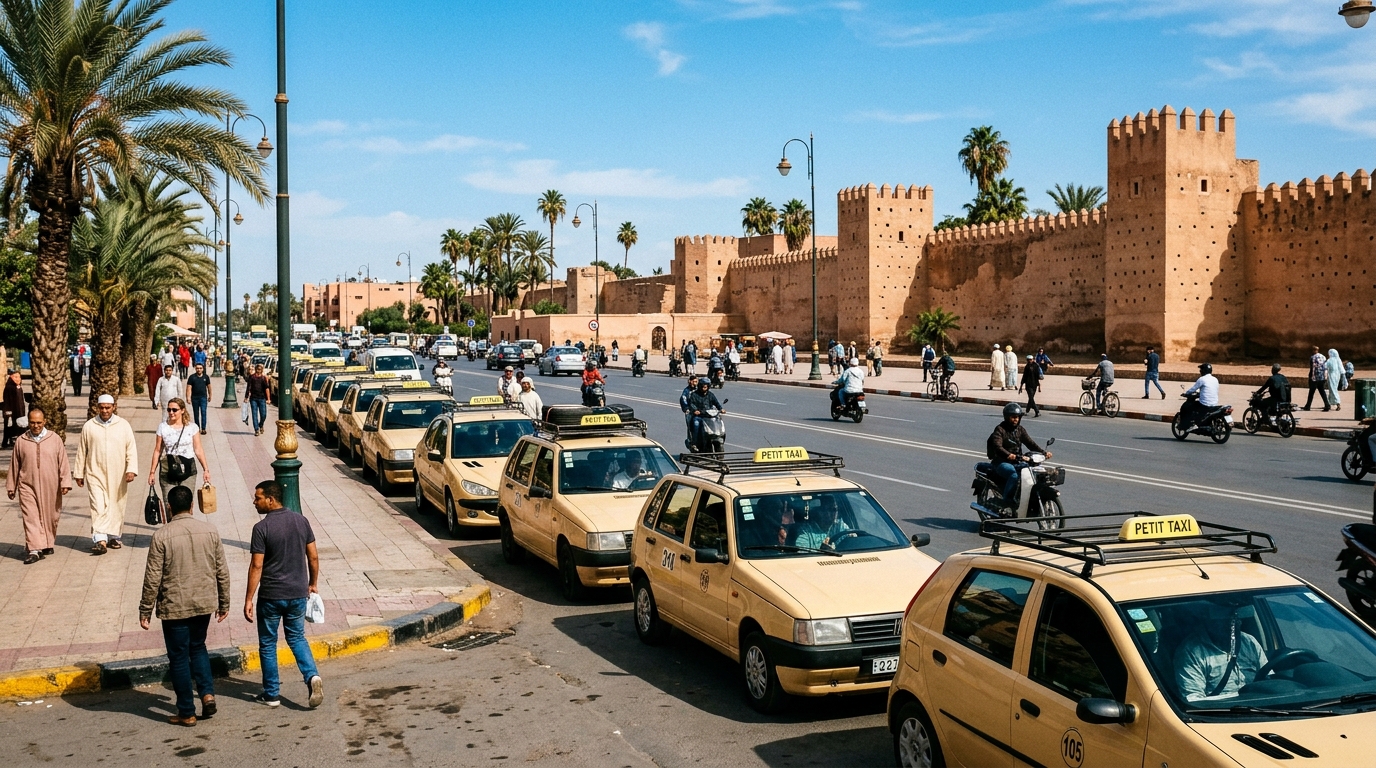
Getting around Marrakech without a rental car is practical, inexpensive, and far less stressful than driving through local traffic. The city operates on two distinct transportation networks: the labyrinth of medieval pedestrian alleys inside the walled medina, where pack donkeys and motorbikes weave through crowds, and the broad avenues of modern Gueliz and Hivernage, serviced by ochre-colored city taxis and municipal buses. Learning how these transit systems operate before you land saves time and money.
Many travelers arrive expecting that renting a car will give them freedom to explore. In reality, cars cannot enter the historic medina, where thousands of residential alleys (derbs) are strictly pedestrian. In the new city, navigating roundabouts without lane markings, competing with swarms of scooters, and negotiating parking creates needless tension. With a clear grasp of taxi meter rules, airport express buses, inter-city train connections, and walking etiquette, you can move across Marrakech with complete confidence.
The Petit Taxi playbook: meters, tariffs, and overcharging defenses
Small ochre-colored city cabs, known across Morocco as Petit Taxis, handle point-to-point urban travel in Marrakech. These vehicles (mainly Dacia Logans, Fiat Unos, and Peugeot 206s) are licensed to carry a maximum of three passengers within municipal boundaries. If your party has four people, Moroccan regulations require splitting into two cabs or hiring a private minivan.
By municipal law, every Petit Taxi in Marrakech is equipped with an electronic meter, known in French as le compteur. The legal daytime flag drop begins at 2.50 MAD, with a legal minimum fare of 7.50 MAD ($0.75 USD). A standard trip between medina gates (such as Bab Doukkala or Bab Ksour) and central shopping streets of Gueliz or the train station typically costs between 15 and 25 MAD ($1.50 to $2.50 USD) on the meter.
Between 8:00 PM and 6:00 AM, a nighttime tariff applies. By law, the night rate adds a 50 percent surcharge to the daytime meter rate, bringing the starting flag drop to roughly 3.75 MAD and the legal minimum fare to 10.00 MAD ($1.00 USD). A ride costing 18 MAD by day will legally cost 27 MAD at night.
The tourist rank dilemma
While the law is clear, on-the-ground enforcement varies. Drivers parked at high-traffic tourist ranks (directly outside Jemaa el-Fna, outside luxury hotels on Avenue Mohammed VI, or outside the Gare de Marrakech train station) routinely refuse to activate the meter. When asked for a ride, they quote flat inflated rates of 70 to 100 MAD ($7.00 to $10.00 USD) for a three-kilometer journey that costs under 20 MAD on the meter.
To secure a legal metered fare, follow this straightforward protocol:
- Never approach the first parked taxi sitting directly outside major monuments, hotel gates, or busy plazas.
- Walk 50 to 100 meters away from the rank to a main road where cabs are in motion, such as Boulevard El Yarmouk or Avenue Mohammed V.
- Flag down an oncoming cab with a raised hand.
- Before stepping inside, state your destination and request the meter: “Gueliz, le compteur s’il vous plaît?” (or in Moroccan Darija: “Khdem l’compteur, afak”).
- If the driver nods or starts the meter, get in. If the driver refuses, wave politely and wait for the next cab. An empty taxi passes every twenty to thirty seconds along primary avenues.
Understanding the collective ride system (Course Collective)
Do not worry if your driver stops to pick up another passenger while you are in the car. This practice is entirely legal in Morocco, known as a course collective. The driver may pick up additional riders traveling in the same direction until all three passenger seats are full.
Each passenger pays for their own journey according to the meter reading. When a new passenger boards, the driver notes the meter reading and calculates each fare independently. If you prefer a private ride, request a private charter (course) when boarding.
| Common Taxi Route | Legal Meter Fare (Day) | Legal Meter Fare (Night) | Typical Quoted Tourist Fare |
|---|---|---|---|
| Medina (Bab Doukkala) to Gueliz Plaza | 12 to 18 MAD (~$1.50 USD) | 18 to 27 MAD (~$2.20 USD) | 50 to 80 MAD |
| Gare ONCF (Train Station) to Jemaa el-Fna | 15 to 22 MAD (~$1.80 USD) | 22 to 33 MAD (~$2.80 USD) | 70 to 100 MAD |
| Jemaa el-Fna to Jardin Majorelle | 15 to 25 MAD (~$2.00 USD) | 22 to 38 MAD (~$3.00 USD) | 60 to 100 MAD |
| Medina to Palmeraie Resorts | 45 to 65 MAD (~$5.50 USD) | 70 to 100 MAD (~$8.50 USD) | 100 to 150 MAD |
Airport arrivals: Line 19 express bus vs official taxi rank
Marrakech Menara Airport (RAK) sits only six kilometers southwest of the city center. However, exiting the arrivals hall into taxi ranks is where travelers often encounter pricing disputes.
The ALSA Line 19 express bus
The municipal transit authority (ALSA) operates a dedicated airport express bus, Line 19, running directly between Menara Airport and the city center. The bus stops outside the terminal building, roughly 50 meters to the left as you exit Terminal 1.
Line 19 operates daily from roughly 6:00 AM until 11:30 PM, departing every 20 to 30 minutes. The bus loops through Hivernage, stops at the Marrakech Central Train Station (Gare ONCF), passes Bab Doukkala on the northwest medina wall, and terminates directly at Jemaa el-Fna (at the Arset El Bilk stop), before returning to the airport.
Tickets cost 30 MAD ($3.00 USD) for a one-way trip or 50 MAD ($5.00 USD) for a return ticket valid for two weeks. Keep the paper receipt to present to the driver on your departure day. You purchase the ticket directly from the driver using cash dirhams. The buses are modern coaches equipped with interior luggage racks. For solo travelers or couples carrying rolling suitcases, Line 19 is the most cost-effective transit option from the airport.
The official airport taxi rank and fixed rates
If you travel with heavy luggage, arrive late at night, or travel with family, an airport taxi is practical. The prefecture sets official flat-rate airport taxi fares, displayed on a printed board above the designated taxi rank in the parking plaza outside arrivals:
- Daytime rate (6:00 AM to 8:00 PM): 100 MAD ($10.00 USD) for a Petit Taxi (1 to 3 passengers) to anywhere in the Medina, Gueliz, or Hivernage.
- Nighttime rate (8:00 PM to 6:00 AM): 150 MAD ($15.00 USD) for a Petit Taxi to the same central districts.
- Palmeraie destinations: Official rates are 150 MAD by day and 200 MAD by night.
When walking past the terminal exit doors, you will pass informal touts offering rides for 200 to 300 MAD. Walk past them to the official marked rank. Confirm the posted tariff with the rank coordinator before getting into the car. The flat fare covers all passengers and luggage in the trunk; drivers are not legally permitted to demand supplemental baggage fees.
Inter-city hubs: ONCF train station and bus terminals
If you arrive in Marrakech from Casablanca, Rabat, Tangier, or Essaouira, you will disembark at one of several inter-city transit terminals.
Gare de Marrakech (ONCF Train Station)
Located on Boulevard Hassan II in Gueliz, the Marrakech central train station is an air-conditioned facility with an ornate geometric facade. Trains operated by the national rail company (ONCF) arrive regularly from Casablanca (2 hours 45 minutes) and Tangier (5 hours via high-speed connection). Inside the concourse, you will find clean public restrooms, a food court, and multiple bank ATMs from Attijariwafa Bank and BMCE.
When exiting station doors, ignore drivers offering rides into the medina for 80 to 100 MAD. Step across the plaza to Boulevard Hassan II or Avenue Mohammed VI. Hail a moving Petit Taxi on the street and ensure the meter is running. The metered fare from the train station to Bab Doukkala or Jemaa el-Fna is 15 to 22 MAD during the day.
CTM and Supratours coach terminals
Morocco has two premium long-distance bus companies, both offering air-conditioned coaches with assigned seating and luggage tagging:
- Supratours: Owned by the national railway (ONCF), the Supratours terminal sits directly behind the Marrakech Train Station on Rue Abou Bakr Seddik. This is the primary departure point for coastal buses to Essaouira (100 to 130 MAD, 3 hours) and desert routes south toward Ouarzazate and Zagora. Transferring from an arriving train to a Supratours bus requires only a two-minute walk.
- CTM: The Compagnie de Transports au Maroc operates from its dedicated terminal on Boulevard Mohamed Zerktouni in Gueliz, roughly one kilometer north of the train station. CTM coaches run extensive routes across Morocco. Tickets can be booked in advance via the CTM mobile app. Expect to pay a small cash fee of 5 MAD per checked bag at the luggage scale before boarding.
Gare Routière Bab Doukkala (Regional bus station)
Situated outside the northwestern medina gate at Bab Doukkala, this is the regional bus terminal. It serves non-CTM local buses and northern shared Grand Taxis heading toward smaller rural towns. It is crowded and attended by commission touts. Unless you are an experienced budget traveler looking for local connections to smaller market towns, stick to CTM or Supratours for long-distance travel.
Grand Taxis for regional travel
While Petit Taxis operate strictly within city limits, Grand Taxis handle regional routes into the High Atlas Mountains. These vehicles are shared minivans or older white Mercedes sedans that operate on fixed routes without meters.
Grand Taxis operate on the shared seat principle (blasa). The vehicle departs when all six passenger seats are sold (or when a passenger pays for empty seats to depart immediately). The primary Grand Taxi rank for mountain excursions toward Asni, Imlil (the trailhead for Mount Toubkal), and the Ourika Valley is located outside the southern medina wall at Bab er-Rob:
- A single seat in a shared Grand Taxi from Bab er-Rob to Imlil costs 40 to 50 MAD ($4.00 to $5.00 USD).
- To charter the entire vehicle privately without waiting for other passengers, pay for all six seats: 240 to 300 MAD ($24.00 to $30.00 USD).
- A shared seat to Setti Fatma in the Ourika Valley costs 25 to 35 MAD ($2.50 to $3.50 USD), or approximately 180 to 220 MAD to charter the car.
Walking navigation and medina pedestrian etiquette
Walking is the only way to explore the heart of the medina. The historic district is a living city of roughly 40,000 residents, artisans, and merchants, all sharing narrow lanes without sidewalks.
The cry of Balak! and dealing with mopeds
As you walk along market streets, you will hear a sharp cry: “Balak! Balak!” (بالك بالك). This is Moroccan Arabic for “Look out! Make way!”
When you hear Balak, step to the right side of the alley and pause against the wall. The cry usually signals a heavy wooden cart pushed by an artisan, a donkey carrying goods, or a moped accelerating through the passage. Scooters (mobylettes) navigate the same narrow lanes as pedestrians. Avoid wearing headphones while walking in the medina; keeping your ears open ensures you hear approaching engines before they reach your elbow.
Offline digital maps vs street signs
Street names in the medina are rarely signed, and traditional paper maps are of little use in covered alleys.
Google Maps frequently loses GPS accuracy when walking under cedar lattice awnings or through dense residential derbs. Before your first walk, download an offline navigation application that uses OpenStreetMap data, such as Maps.me or Organic Maps. OpenStreetMap volunteers have mapped nearly every pedestrian archway, public fountain, and dead-end derb in the Marrakech medina with high positional accuracy.
Frequently Asked Questions
What should I do if a taxi driver refuses to turn on the meter?
If a driver refuses to activate the meter (le compteur), decline the ride politely, step away from the car, and hail the next passing cab. Never argue or raise your voice. In busy areas like Gueliz and main medina gates, a moving taxi passes every thirty seconds. If you are in an isolated area where other cabs are scarce, negotiate a realistic flat rate before boarding based on standard tariffs (such as 20 to 25 MAD for a short city trip).
Is the Line 19 airport bus easy to use with large suitcases?
Yes. The ALSA Line 19 express bus uses full-sized modern city coaches with wide interior luggage storage racks and low-floor boarding doors. It costs 30 MAD for a single ride or 50 MAD for a return ticket valid for two weeks. It stops outside Menara Airport terminal and connects directly to Hivernage hotels, the Gare ONCF train station, Bab Doukkala, and Jemaa el-Fna.
Can you rent a car and drive inside Marrakech?
Renting a car to drive inside Marrakech is not recommended. The medina is entirely pedestrianized, parking in the new city is difficult, and local traffic involves heavy moped congestion and complex roundabouts. Rent a car only if you are departing Marrakech to drive yourself across the High Atlas Mountains or down toward the Sahara Desert.
How do I catch a taxi from the Marrakech train station without getting overcharged?
When exiting the Gare de Marrakech, ignore the aggressive drivers waiting directly on the station steps who quote flat rates of 80 to 100 MAD. Walk across the exterior plaza to Boulevard Hassan II or Avenue Mohammed VI, flag down an active passing Petit Taxi, and say: “Le compteur, s’il vous plaît.” The metered daytime fare from the train station to medina gates like Bab Doukkala or Jemaa el-Fna is between 15 and 22 MAD.
What does “Balak” mean when walking through the Marrakech medina?
Balak! is the Moroccan Arabic warning for “Look out!” or “Make way!” It is shouted by cart pushers, donkey drivers, and moped riders navigating tight pedestrian corridors. When you hear it, step calmly to the right edge of the street against the wall until the cart or vehicle has passed.
Related Morocco Travel Planning Guides
Connect your transport plans with our comprehensive destination and attraction resources:
- Marrakech travel guide: Complete first-timer planning guide, neighborhood breakdowns, fast facts, and citywide overview.
- Things to do in Marrakech: Top historical monuments, Bahia Palace, Saadian Tombs, Ben Youssef Madrasa, and garden tickets.