
Preparing the logistical details of your trip to Marrakech prevents small frustrations that disrupt travel. The city operates on customs that differ from European and North American norms: cash remains the primary payment method across the medina, mobile phone registration follows strict national regulations, and municipal water systems contain mineral profiles that challenge foreign digestive systems. Understanding how to handle mobile data, secure cash at bank machines without excessive conversion fees, and treat minor ailments will keep your journey running smoothly.
Travelers often research riads and tours while overlooking practical foundations: where to get an authentic data connection, why foreign debit cards are rejected at specific ATMs, and how to buy medications in neighborhood pharmacies. Grounding your trip in verified prices and practical local knowledge eliminates guesswork.
Mobile connectivity: Maroc Telecom vs Orange vs Inwi & eSIMs
Reliable mobile internet in Marrakech is essential for pedestrian navigation, communicating with riad hosts via WhatsApp, and confirming departure times with excursion drivers. Morocco has three licensed national telecommunications operators: Maroc Telecom (IAM), Orange Morocco, and Inwi.
Operator comparison and coverage realities
Coverage varies by region:
- Maroc Telecom: The former state operator maintains the most extensive network in Morocco. If your trip extends into the High Atlas, Amazigh villages, the Agafay Desert, or across Tizi n’Tichka to the Sahara, Maroc Telecom provides the most reliable 4G signal.
- Orange Morocco: Orange provides fast 4G and 5G connectivity throughout Marrakech city limits, Gueliz, the medina, and major urban centers like Casablanca and Rabat. Staff in Gueliz shops speak French and English.
- Inwi: Inwi is the budget operator. Speeds within central Marrakech are reliable, but coverage drops quickly once you drive into rural mountain valleys or remote desert highways.
Airport SIM counters vs official city stores
In the arrivals hall at Marrakech Menara Airport (RAK), operators run promotional counters offering “free SIM cards.”
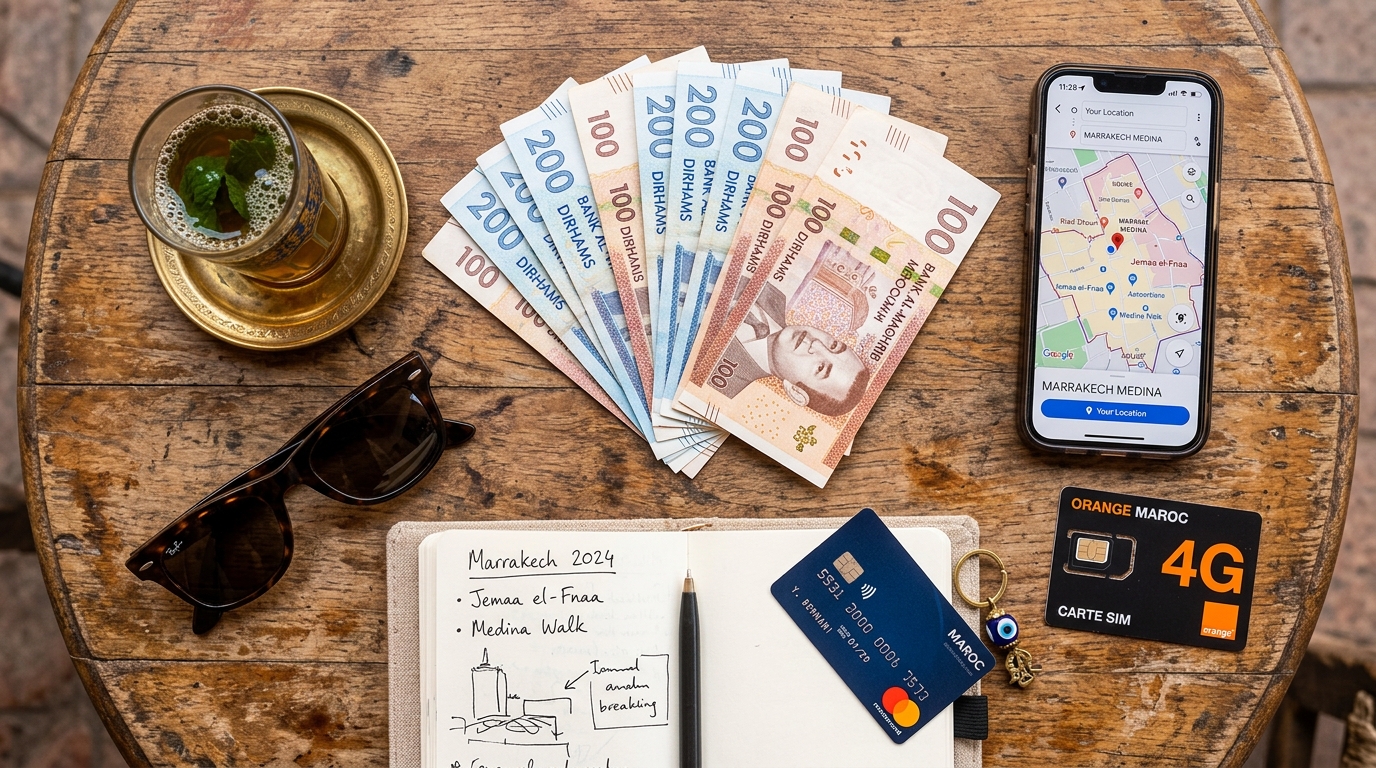
While the plastic card is free, airport staff push overpriced bundles charging 200 to 300 MAD ($20 to $30 USD) for 15 to 20 GB. By contrast, the official standard domestic tariff across Morocco is exactly 10 MAD ($1.00 USD) per 1 GB of data.
To save money, take the Line 19 bus or a taxi to your accommodation using offline maps. Walk to an official Maroc Telecom or Orange store in Gueliz or near Bab Doukkala. You can purchase a prepaid physical SIM card for 20 to 30 MAD ($2.00 to $3.00 USD) and load data at the standard rate.
Moroccan law requires identity registration for every active SIM card. You must present your original physical passport (jawaz safar). The clerk will photograph your passport before activating the card on the national network. Never buy pre-activated SIM cards from street peddlers, as unregistered lines are disconnected within days.
How to top up your data balance (The *3 rule)
To add data during your stay, visit any neighborhood convenience shop (hanout) or tobacco kiosk. Ask the clerk for a recharge:
- Buy a scratch card: 20 MAD (2 GB), 50 MAD (5 GB), or 100 MAD (10 GB).
- Moroccan operators use numerical suffixes to separate call minutes from data. When entering the voucher code on Maroc Telecom, append *3 to the end.
- For example, enter `[scratch-code]*3` to credit the balance as pure data. Omitting *3 registers the credit as voice airtime, which data usage drains quickly.
Physical local SIM vs international travel eSIM
If your phone supports digital eSIMs and you prefer landing with active data, providers like Airalo or Holafly are convenient. However, consider these trade-offs:
- An international eSIM typically costs $15 to $35 USD for 3 to 10 GB of data, roughly three times the cost of local Moroccan data.
- Travel eSIMs are data-only profiles routed through European roaming gateways, which can cause higher latency.
- A data-only eSIM lacks a local Moroccan phone number (+212), which is helpful for receiving calls from riad porters, coordinating with taxi drivers, and booking dinner tables.
| Connectivity Option | Approximate Cost (MAD) | Approximate Cost (USD) | Local Number Included? | Best For |
|---|---|---|---|---|
| Local Maroc Telecom SIM | 50 to 120 MAD | $5 to $12 | Yes (+212 number) | Best overall coverage, Atlas trips, and calling drivers. |
| Local Orange Morocco SIM | 50 to 120 MAD | $5 to $12 | Yes (+212 number) | City travelers staying in Marrakech, fast urban data. |
| Prepaid Travel eSIM (Airalo) | 100 to 250 MAD | $10 to $25 | No (Data only) | Short visits, arriving with instant maps, phones without SIM trays. |
Money, ATMs, and currency management in a cash economy
The Moroccan Dirham (MAD) is an officially restricted currency that cannot be traded on international currency markets outside Morocco. You cannot withdraw dirhams from your home bank before your flight, and you cannot export more than 2,000 MAD upon departure.
Morocco remains a cash society. While boutique hotels, supermarkets like Carrefour, and upscale restaurants in Gueliz accept cards, the medina operates on paper cash (flous). Souk stalls, fruit vendors, cafes, ticket booths, and Petit Taxis do not accept credit cards.
ATM withdrawal strategies and bank choices
Bank automated teller machines (known in French as a Guichet Automatique Bancaire or GAB) are widespread throughout Marrakech, with clusters around Jemaa el-Fna, along Avenue Mohammed V in Gueliz, and inside the Gare de Marrakech train station.
When withdrawing cash, keep these operational rules in mind:
- Per-transaction limits: Most Moroccan bank ATMs cap individual withdrawals at 2,000 to 3,000 MAD ($200 to $300 USD) per transaction. If you need 6,000 MAD to settle a riad bill, insert your card two or three times consecutively. Ensure your home bank does not block consecutive foreign transactions.
- Al Barid Bank: The postal bank of Morocco (Al Barid Bank) is generally the most economical choice. In many branches, Al Barid machines charge zero local operator fees for international debit cards. Commercial banks like Attijariwafa Bank and BMCE often assess a fee of 20 to 35 MAD ($2.00 to $3.50 USD) on foreign cards.
- Physical safety: Choose machines located inside well-lit bank lobbies with security guards rather than isolated exterior walk-up machines along medina corridors.
The Dynamic Currency Conversion (DCC) trap
When requesting a cash withdrawal, the ATM screen will prompt you to charge your home bank account in US Dollars, Euros, or British Pounds at a “guaranteed locked exchange rate.” This is Dynamic Currency Conversion (DCC). The bank terminal applies a profit markup of 5 to 10 percent above the official interbank rate for the “convenience” of showing your home currency.
Always select “Decline Conversion” or “Debit in Local Currency (MAD)” so your home bank converts the funds at fair interbank rates.
Currency exchange and small change (Sarf)
Avoid airport baggage claim exchange booths, which impose wide spreads. Exchange only $20 at the airport for initial transit.
For fair cash exchange rates without commissions, head to established medina exchange offices. One of the most reliable exchange desks in Marrakech is at Hotel Ali, on the southwest corner of Jemaa el-Fna along Rue Moulay Ismail. Their posted daily rates closely mirror official central bank interbank rates with minimal spread.
ATMs dispense large 100 MAD and 200 MAD notes. Paying for a 15 MAD taxi fare with a 200 MAD note causes friction. Break large notes at sit-down restaurants or monument gates. Keep small coins and 20 MAD notes (sarf) in a separate pocket to pay for cabs, restrooms (2 to 5 MAD), and porters.
Water safety, food hygiene, and digestive health
Digestive issues can disrupt a short trip, but understanding local water treatment and basic hygiene minimizes risk.
The tap water verdict
Municipal tap water in Marrakech is chlorinated, treated, and meets national standards. Local residents drink tap water daily without issue, but international visitors should not drink it.
The issue for visitors is not bacterial infection, but high dissolved mineral content and unfamiliar chlorination profiles that challenge unadapted digestive systems. Drinking tap water regularly causes mild bloating or cramping.
- Brushing teeth: Rinsing your toothbrush with municipal tap water in established riads and modern hotels is safe for most healthy adults. If you have a sensitive stomach, use bottled water.
- Ice in drinks: In established sit-down restaurants, modern cafes, and licensed riads, ice is made from commercially purified water and is safe to consume. In informal street stalls, decline ice.
- Washed vegetables: Fresh salads at reputable restaurants are washed thoroughly. At street stalls, stick to cooked foods served hot directly from charcoal grills.
Bottled water brands
Bottled spring water is inexpensive and sold at every neighborhood grocery shop (hanout):
- Sidi Ali: The most common still spring water brand, bottled from mountain sources in the Middle Atlas. A 1.5-liter bottle costs 5 to 7 MAD ($0.50 to $0.70 USD) at corner shops (tourist cafes on Jemaa el-Fna charge 15 to 25 MAD). A small 0.5-liter bottle costs 3 to 5 MAD.
- Ain Saiss: A widely available still mineral water with low mineral content and a neutral taste.
- Oulmès: Morocco’s popular naturally sparkling carbonated mineral water, packaged in dark green bottles.
Inspect the plastic cap seal before purchasing bottled water from street kiosks to confirm it has not been refilled.
Preventing and treating traveler’s diarrhea
Digestive upset (known as kharbaq l’kersh or wajaa) is usually caused by dietary changes, olive oil, spices, and heat rather than food poisoning.
To protect your stomach, wash hands thoroughly, or use alcohol sanitizer before tearing bread (khobz) with your fingers. Pack oral rehydration salts (ORS) in your travel kit. Replacing electrolytes is essential in Marrakech’s dry heat. Do not take anti-motility drugs (like Loperamide) at the first loose stool. Allow your digestive tract to naturally clear mild irritants, relying on rehydration salts and bland foods (rice, bananas, bread). Use anti-motility medication only when boarding long transit legs.
Medical emergencies, pharmacies, and travel insurance
If you face a medical problem, Marrakech has solid private healthcare infrastructure, including skilled physicians and modern surgical clinics.
The Moroccan pharmacy system
Pharmacies in Morocco display bright, illuminated green crosses outside their doors. Moroccan pharmacists can evaluate common conditions and dispense medications over the counter.
Most pharmacists in central Marrakech speak French, Arabic, and English. If you experience an upset stomach, ear infections, rashes, or heat exhaustion, visit a neighborhood pharmacy. They can dispense rehydration packets, anti-nausea medication, and analgesics for modest cash sums (typically 40 to 100 MAD).
Moroccan cities operate a rotating night pharmacy system called the Pharmacie de Garde. During night hours and Sundays, designated neighborhood pharmacies remain open for emergency medications. Every closed pharmacy posts a list in its front window indicating which nearby pharmacy is currently on night duty.
Private clinics and hospitals
If you need diagnostic tests or emergency medical treatment, avoid public municipal hospitals, which face crowding and resource limits. Request a taxi to a reputable private clinic:
- Polyclinique du Sud: Located on Rue de la Yougoslavie in Gueliz. An established private clinic with English- and French-speaking doctors, diagnostic imaging, and 24-hour emergency care.
- Clinique Internationale Marrakech: Situated in the modern district on Route de l’Aéroport. A modern medical facility equipped with advanced cardiology and trauma units.
Private clinics in Morocco require upfront payment via cash dirhams or major credit cards before admitting patients. A consultation with an English-speaking private emergency physician costs between 300 and 500 MAD ($30 to $50 USD). Keep all receipts, medical reports, and itemized billing statements to submit to your travel insurance carrier.
Travel insurance essentials
Confirm your travel insurance covers emergency medical evacuation. If an injury occurs while hiking the High Atlas or riding quad bikes in Agafay, transport to a hospital can incur steep costs without coverage.
Frequently Asked Questions
Where is the best place to buy a Moroccan SIM card in Marrakech?
The best place to buy a SIM card is at an official Maroc Telecom or Orange retail boutique in Gueliz (along Avenue Mohammed V) or near Bab Doukkala. You can purchase a physical SIM for 20 to 30 MAD ($2 to $3 USD) and add data at the standard rate of 10 MAD per 1 GB. Bring your original physical passport, as identity registration is mandatory under Moroccan law.
Which Marrakech ATMs have the lowest withdrawal fees and no dynamic currency conversion?
Al Barid Bank (the Moroccan postal bank) offers the lowest local operator fees, often charging zero dirhams on foreign card withdrawals. Commercial banks like Attijariwafa Bank and BMCE typically assess a fee of 20 to 35 MAD per withdrawal. At any ATM, always press “Decline Conversion” when prompted with a conversion rate to ensure your home bank calculates the exchange at standard interbank rates.
Is the tap water in Marrakech safe to drink or brush teeth with?
Brushing your teeth with tap water is safe in established riads and modern hotels. However, you should not drink tap water directly from the faucet. The high dissolved mineral levels can cause digestive upset in travelers whose systems are not adapted to local water. Purchase inexpensive 1.5-liter bottles of Sidi Ali or Ain Saiss spring water (5 to 7 MAD at local grocery shops) for daily drinking.
What should I do if I get food poisoning or traveler’s diarrhea in Marrakech?
Visit the nearest neighborhood pharmacy (look for the illuminated green cross sign). Pharmacists can assess your symptoms and dispense oral rehydration salts, anti-spasmodic medications, and probiotics for under 100 MAD. Stay hydrated in the dry climate, rest in your air-conditioned riad, and seek private medical care at Polyclinique du Sud or Clinique Internationale Marrakech if fever or severe symptoms persist past 48 hours.
Can I pay with US Dollars or Euros instead of Moroccan Dirhams in Marrakech?
Some luxury riads, fine dining venues, and carpet shops accept Euros or US Dollars, but they apply unfavorable exchange rates that cost you more. For daily spending, food stalls, taxi rides, and souk purchases, you must pay in Moroccan Dirhams (MAD). Carry small banknotes (20 and 50 MAD) and coins for cash transactions.
Related Morocco Travel Planning Guides
Ensure a complete trip preparation by exploring our companion guides to navigating the Red City:
- Marrakech travel guide: Complete first-timer planning guide, neighborhood breakdowns, fast facts, and citywide overview.
- Things to do in Marrakech: Top historical monuments, Bahia Palace, Saadian Tombs, Ben Youssef Madrasa, and garden tickets.